
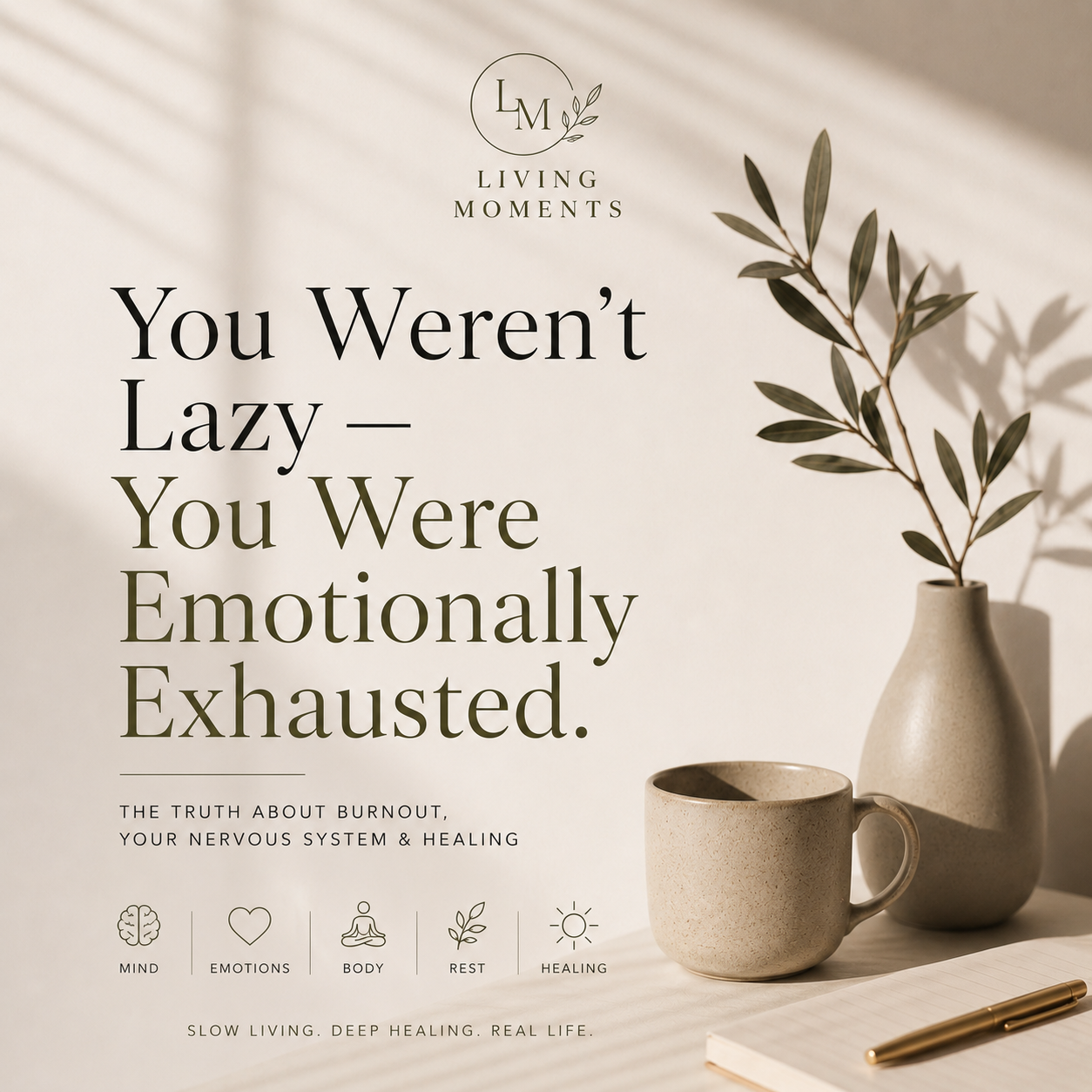
Burnout, Emotional Overload, the Nervous System & Why Rest Is Not Weakness
There is a difference between laziness and exhaustion.
But modern culture often confuses the two.
Many people are not avoiding life because they do not care.
They are emotionally overwhelmed, mentally overstimulated, physically depleted, and psychologically disconnected from themselves.
And after enough time in survival mode, even simple tasks can begin to feel impossibly heavy.
Answering messages feels exhausting.
Getting out of bed feels difficult.
Making decisions feels overwhelming.
Concentrating becomes harder.
Motivation disappears.
Joy feels distant.
Then guilt appears.
And people begin calling themselves:
- lazy,
- unmotivated,
- weak,
- inconsistent,
- undisciplined,
- or “not trying hard enough.”
But exhaustion changes the brain and body in ways many people do not fully understand.
Sometimes what looks like laziness is actually nervous system overload.
The Human Brain Was Not Designed for Constant Stimulation
Modern life places the nervous system under continuous pressure.
Notifications.
Work pressure.
Financial anxiety.
Social comparison.
Endless information.
Productivity culture.
Emotional suppression.
Noise.
Screens.
Fear of falling behind.
Pressure to constantly improve.
The nervous system rarely gets a true pause.
And when stress becomes chronic, the body shifts into survival mode.
Neuroscience research shows that chronic stress increases cortisol production and affects areas of the brain connected to:
- focus,
- memory,
- emotional regulation,
- motivation,
- sleep,
- and decision-making.
\text{Chronic Stress} \rightarrow \text{Nervous System Dysregulation}
The brain begins prioritizing survival over creativity, curiosity, and long-term thinking.
This is why emotionally exhausted people often struggle with:
- procrastination,
- numbness,
- brain fog,
- fatigue,
- low motivation,
- avoidance,
- emotional shutdown,
- and difficulty concentrating.
Not because they are incapable.
But because the nervous system is overloaded.
Burnout Is More Than “Being Tired”
The World Health Organization recognizes burnout as an occupational phenomenon associated with chronic unmanaged stress.
Burnout is commonly associated with:
- exhaustion,
- mental distance,
- cynicism,
- emotional depletion,
- and reduced capacity to function effectively.
But emotional burnout can also happen outside work.
People burn out emotionally from:
- constantly surviving,
- caregiving,
- emotional pressure,
- toxic relationships,
- financial instability,
- academic pressure,
- unresolved trauma,
- perfectionism,
- and years of never truly resting.
Sometimes people become exhausted not from doing too little —
but from carrying too much emotionally for too long.
Emotional Exhaustion Changes Behavior
Psychology research shows that prolonged stress and emotional overload affect executive functioning.
Executive functions include:
- planning,
- motivation,
- organization,
- impulse control,
- attention,
- and emotional regulation.
When the brain becomes overwhelmed, even ordinary tasks require more energy.
This is why emotionally exhausted people may:
- avoid responsibilities,
- isolate socially,
- lose motivation,
- struggle with consistency,
- feel emotionally numb,
- or experience decision paralysis.
The body begins conserving energy for survival.
And unfortunately, many people shame themselves during the exact moment they most need compassion and recovery.
Trauma, Survival Mode & Freeze Responses
Not every nervous system responds to stress through hyperactivity.
Some respond through shutdown.
Trauma research increasingly explores the “freeze response” — a state where the nervous system becomes immobilized under overwhelming stress.
This can look like:
- emotional numbness,
- dissociation,
- exhaustion,
- procrastination,
- inability to start tasks,
- avoidance,
- or feeling mentally disconnected.
Many people think:
“Why can’t I just do it?”
without realizing their nervous system may still be operating from survival responses.
The body is not always resisting productivity.
Sometimes it is trying to protect itself from overload.
Rest Is Biological, Not Laziness
Rest is often treated like a reward in modern culture instead of a biological necessity.
But neuroscience and psychology both show that recovery is essential for:
- cognitive performance,
- emotional regulation,
- memory,
- creativity,
- motivation,
- immune health,
- and nervous system balance.
Sleep deprivation and chronic stress affect:
- dopamine regulation,
- cortisol levels,
- mood,
- focus,
- and emotional resilience.
The body cannot function optimally without restoration.
And emotional rest matters too.
Many people are physically sitting still while remaining mentally overstimulated.
True rest sometimes means:
- silence,
- boundaries,
- emotional safety,
- slowing down,
- reducing stimulation,
- disconnecting from pressure,
- and allowing the nervous system to recover.
Why Self-Compassion Matters Scientifically
Research in psychology — especially the work of Kristin Neff — shows that self-compassion is associated with:
- greater emotional resilience,
- lower anxiety,
- reduced burnout,
- healthier motivation,
- and improved mental well-being.
Many people believe harsh self-criticism creates discipline.
But chronic self-judgment often increases stress responses and emotional exhaustion.
The nervous system responds differently to shame than to safety.
People grow more sustainably in environments of support than environments of constant internal attack.
Movement Helps the Nervous System Recover
One of the most overlooked tools for emotional exhaustion is movement.
Not punishment-based exercise.
Not aesthetic obsession.
But movement that reconnects the body to regulation.
Research supports the benefits of:
- walking,
- yoga,
- stretching,
- mobility work,
- resistance training,
- and mindful movement
for reducing stress and supporting emotional regulation.
Movement affects:
- dopamine,
- serotonin,
- endorphins,
- sleep quality,
- and nervous system balance.
Sometimes healing begins when the body starts feeling alive again.
The Digital World Keeps Many Nervous Systems Activated
The human brain evolved for periods of stimulation followed by recovery.
But modern digital life often removes recovery entirely.
People wake up and immediately consume:
- notifications,
- bad news,
- comparison,
- urgency,
- advertising,
- productivity pressure,
- endless scrolling,
- emotional overload.
The nervous system never fully exits alert mode.
This is one reason slow living practices feel increasingly important.
Practices like:
- reading,
- walking,
- journaling,
- nature,
- cooking slowly,
- silence,
- mindfulness,
- creative hobbies,
- and intentional routines
help reintroduce regulation into daily life.
Healing Is Not Instant Productivity
One of the most harmful modern beliefs is the idea that healing should immediately make people productive again.
But recovery often begins quietly.
Before motivation returns:
- the nervous system stabilizes,
- sleep improves,
- emotional safety increases,
- overwhelm decreases,
- breathing softens,
- and the body slowly learns that survival mode is no longer necessary every second.
Healing is not linear.
And exhausted people do not need more shame.
They need:
- rest,
- support,
- nervous system regulation,
- boundaries,
- emotional processing,
- movement,
- sunlight,
- connection,
- and time.
Final Reflection
Maybe you were never lazy.
Maybe your nervous system was exhausted from carrying pressure the body was never meant to hold continuously.
Maybe the problem was not your worth.
Maybe the problem was living too long in survival mode while calling it “normal.”
And maybe healing begins the moment you stop asking:
“What’s wrong with me?”
and start asking:
“What has my body been trying to survive?”
Because exhausted people do not need punishment.
They need recovery.
Books & Studies to Explore ✨
Burnout & Emotional Exhaustion
- Burnout: The Secret to Unlocking the Stress Cycle
- World Health Organization — burnout research and stress
Trauma & Nervous System
- The Body Keeps the Score
- Bessel van der Kolk
- Stephen Porges
Self-Compassion & Psychology
- Kristin Neff
- Research on emotional resilience and self-compassion
Neuroscience & Stress
- Research on cortisol, chronic stress, and executive functioning
- Studies on nervous system regulation and emotional recovery
Phrases to Save 🤍
- “You were not lazy. You were emotionally overloaded.”
- “A nervous system in survival mode struggles to create.”
- “Rest is not weakness. It is biological recovery.”
- “Burnout is what happens when exhaustion becomes normalized.”
- “Your body cannot heal in constant emergency mode.”
- “Healing sometimes looks like slowing down first.”
- “Self-compassion regulates what shame exhausts.”
- “Exhausted people need care, not guilt.”
