
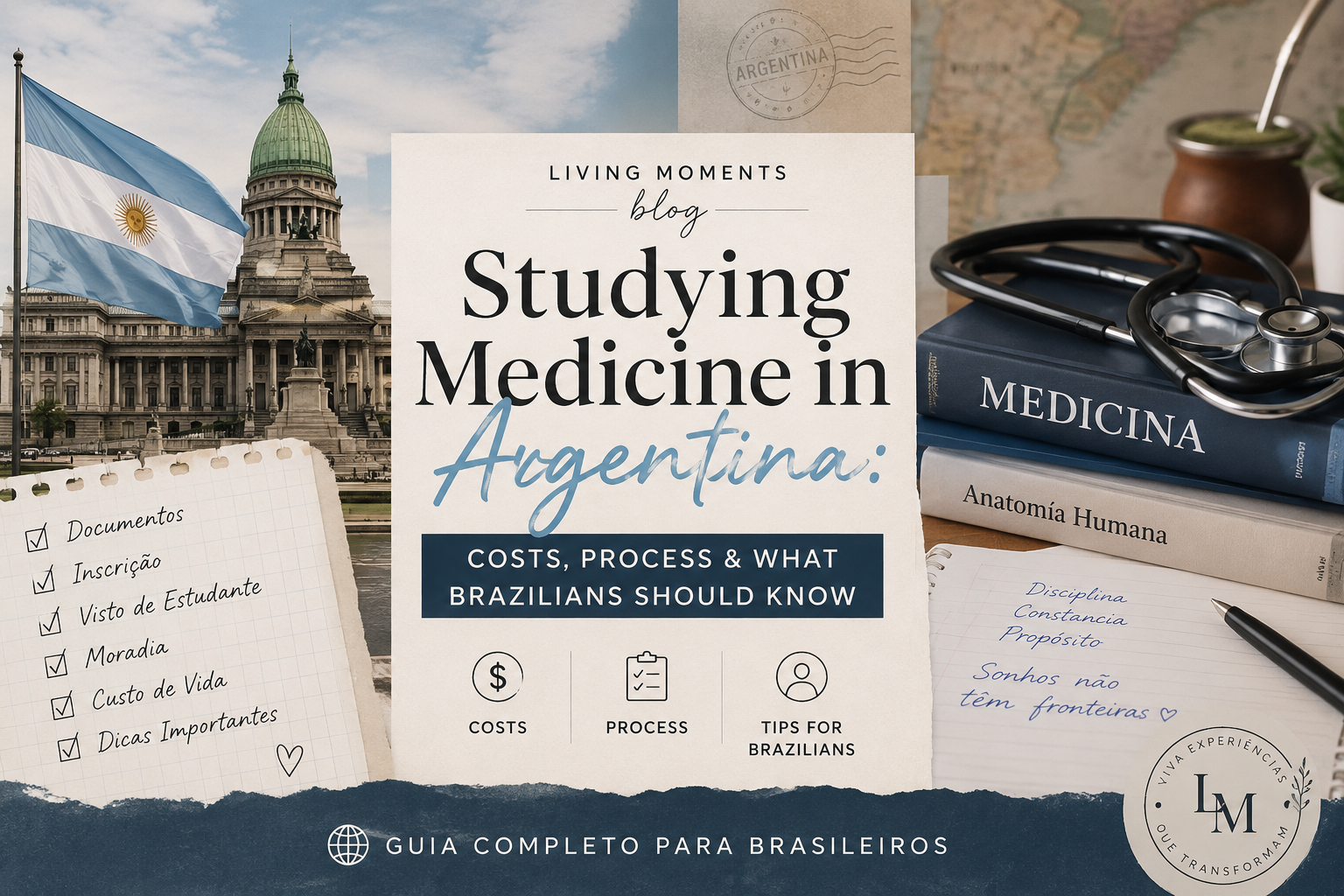
An honest guide based on real experience—from living and studying medicine in Rosario to understanding the realities of costs, universities, and life beyond Buenos Aires.
For thousands of Brazilian students, studying Medicine in Argentina has long represented more than an affordable alternative.
It’s the opportunity to pursue a dream that often feels financially impossible in Brazil.
It’s a chance to become independent.
To learn another language.
To live abroad.
To discover another culture while staying relatively close to home.
I was one of those students.
I studied Medicine in Rosario, lived the daily routine of being a Brazilian student abroad, and experienced both the incredible opportunities and the challenges that rarely appear on social media.
Today, Argentina is different from when many older YouTube videos or blog posts were published.
The country has experienced significant inflation over the last few years. Prices change frequently, and planning your budget has become much more important than it used to be.
If you’re considering studying Medicine there, here’s what I wish someone had honestly explained to me before I moved.
Why Argentina Became So Popular Among Brazilian Students
For many years, Argentina became one of the main destinations for Brazilians interested in Medicine because it offered opportunities that simply didn’t exist for many families in Brazil.
Some of the biggest advantages include:
• Internationally respected medical education
• Traditional universities with decades of academic history
• Geographic proximity to Brazil
• Cultural similarities that make adaptation easier
• Spanish immersion
• Strong Brazilian student communities
• A chance to live independently while studying
Unlike moving to Europe or North America, Argentina often feels like a manageable first experience abroad.
It’s different enough to challenge you.
Yet familiar enough that you don’t feel completely disconnected from home.
Beyond Buenos Aires: Why I Chose Rosario
When people think about studying in Argentina, Buenos Aires usually comes to mind first.
But Argentina is much more than its capital.
I studied in Rosario, one of the country’s largest cities and an important university center.
Located about 300 km northwest of Buenos Aires, Rosario sits on the Paraná River and has a completely different rhythm.
It’s quieter.
Less chaotic.
Less expensive than Buenos Aires in many aspects.
And surprisingly easy to navigate.
One of the things I appreciated most was how walkable the city is.
Many students walk or cycle to university.
Public buses cover most neighborhoods efficiently.
Taxis and ride-sharing services are generally affordable compared to many large international cities.
Unlike massive capitals where commuting can consume hours every day, Rosario often allows students to spend less time in traffic and more time studying—or simply enjoying life.
The city also has beautiful riverside parks, cafés, bookstores, green spaces, and an active student community.
It feels like a city built for university life.
Other Cities Worth Considering
Although Buenos Aires receives most of the attention, several Argentine cities are home to excellent medical schools.
Many students also consider:
• Córdoba – another major university city with vibrant student life.
• Rosario – balanced cost of living, excellent transportation and a calmer pace.
• Santa Fe – smaller and often more affordable.
• Mendoza – beautiful scenery near the Andes with a growing student community.
Smaller cities often provide lower living costs and a quieter environment for studying, although they may offer fewer entertainment options than Buenos Aires.
Choosing a city isn’t only about the university.
It’s about imagining where you’ll spend six or more years of your life.
Studying at IUNIR: My Experience
I studied at Instituto Universitario Italiano de Rosario (IUNIR).
Unlike Argentina’s public universities, IUNIR is a private institution.
That means tuition is required.
However, one advantage many students appreciate is the smaller class sizes and, in many cases, a more structured academic schedule.
Administrative processes can also feel more organized compared to some larger public institutions.
Of course, this comes with a higher financial investment.
For students whose families can afford tuition—or who carefully plan their finances—it may be an option worth considering.
As always, tuition fees can change every year, so it’s important to check directly with the university before making any decisions.
What About UNR?
One of Rosario’s most famous institutions is the National University of Rosario (UNR), a respected public university that attracts many Brazilian students.
Its greatest advantage is obvious:
Public education.
However, it’s important to understand that “free” doesn’t necessarily mean “easy.”
Medicine at UNR has a reputation for being academically demanding.
Many students take longer than the official program length to graduate.
This doesn’t happen because the education is poor.
Quite the opposite.
The academic standards are high.
Some subjects have significant failure rates.
Schedules can change.
Course availability may vary.
Progress often depends on passing each stage successfully.
Many students eventually graduate after eight, nine, or even more years, depending on their individual journey.
That doesn’t mean everyone follows that timeline, but it’s something future students should understand before making a decision.
Choosing between a public and private university isn’t simply a financial decision.
It’s also about your learning style, expectations, and long-term goals.
Do You Need an Entrance Exam?
Admission depends on the institution.
Unlike Brazil’s vestibular or ENEM system, Argentina follows different admission models.
Some universities require introductory courses or leveling programs.
Others focus on documentation and academic requirements.
Requirements can change over time, so always confirm directly with your chosen university.
Learning Medicine in Spanish
Many Brazilians underestimate this part.
Speaking Spanish during daily life is one thing.
Studying anatomy, pathology, pharmacology, physiology and clinical medicine entirely in Spanish is another.
At first, everything feels slower.
You’ll probably mix Portuguese and Spanish.
You’ll look up vocabulary constantly.
You’ll reread textbooks more than once.
But immersion accelerates learning.
Within months, you’ll notice remarkable progress.
Eventually, Spanish becomes natural.
Not only in conversations.
But inside the classroom, hospitals and clinical rotations.
The Reality of the Cost of Living in Argentina
This is probably the biggest question students ask today.
And the answer has changed dramatically over the last few years.
Argentina has gone through a period of very high inflation.
Prices don’t simply increase once a year.
Many products and services may change price several times throughout the year.
That means the budget one student shares online today may no longer be accurate a few months later.
Planning with flexibility is essential.
As of today, a Brazilian student should generally expect monthly expenses such as:
• Rent (shared apartment): around R$ 1.000–R$ 2.000 equivalent, depending on the city and exchange rate.
• Private studio apartment: approximately R$ 2.000–R$ 3.500+ equivalent.
• Groceries: R$ 800–R$ 1.500 per month, depending on eating habits.
• Public transportation: relatively inexpensive, especially outside Buenos Aires.
• Mobile phone and internet: affordable compared to many countries.
• Utilities: may or may not be included in rent.
• Study materials, printing and books: additional monthly expenses.
These values fluctuate frequently because of inflation and currency exchange rates, so they should only be used as broad estimates rather than fixed numbers.
One lesson every student learns quickly in Argentina is to always keep an emergency financial reserve.
Unexpected price adjustments are part of everyday life.
Is Buenos Aires More Expensive?
Generally, yes.
Buenos Aires usually has:
Higher rent.
More tourism.
More nightlife.
Greater international influence.
A faster pace.
Rosario and many other cities often offer a lower cost of living while maintaining an excellent quality of education.
For students focused primarily on studying rather than nightlife or tourism, this balance can be very attractive.
Daily Life as a Student
Life eventually settles into a rhythm.
Morning classes.
Coffee before lectures.
Hours in the anatomy lab.
Study groups.
Buying groceries after class.
Walking home.
Weekend review sessions.
Video calls with family.
Little by little, the city begins to feel familiar.
You develop favorite cafés.
Favorite bakeries.
Favorite parks.
You stop feeling like a visitor.
And begin feeling like a resident.
Things That May Surprise Brazilians
Argentina has many small cultural differences that become part of daily life.
People usually have dinner later than in Brazil.
Mate is everywhere and often shared among friends.
Walking is part of everyday life.
Public parks are full on weekends.
Bookstores and cafés play an important role in student culture.
Healthcare discussions are common because medicine is a highly respected profession.
And yes…
You’ll probably end up developing strong opinions about medialunas, empanadas and alfajores.
Challenges Nobody Talks About Enough
Living abroad is rewarding.
But it can also be emotionally demanding.
You’ll likely experience:
Homesickness.
Academic pressure.
Financial stress.
Administrative paperwork.
Language adaptation.
Moments of self-doubt.
That’s completely normal.
Studying Medicine is already difficult.
Doing it in another country adds another layer of complexity.
But it also builds resilience unlike almost anything else.
Is It Worth It?
For many students, absolutely.
Not simply because of the degree.
But because of everything that happens outside the classroom.
You learn another language.
You become financially responsible.
You solve problems alone.
You build friendships from different cultures.
You discover how capable you really are.
Those lessons stay with you long after graduation.
Final Thoughts
Studying Medicine in Argentina isn’t simply about becoming a doctor.
It’s about growing up.
It’s about learning to build a life from scratch.
Argentina today is different from a decade ago.
The economy has changed.
Living costs require more planning.
Inflation has made financial organization more important than ever.
Yet the country continues to offer extraordinary educational opportunities for students willing to embrace both the rewards and the challenges.
Whether you choose Buenos Aires, Rosario, Córdoba or another Argentine city, remember that your experience won’t be defined only by the university you attend.
It will also be shaped by the friendships you build, the language you learn, the independence you gain and the person you become along the way.
Sometimes the greatest lesson isn’t found inside the anatomy lab.
It’s discovering that you’re capable of building a home—even thousands of kilometers away from the one where your journey began.
— Living Moments ✨
