
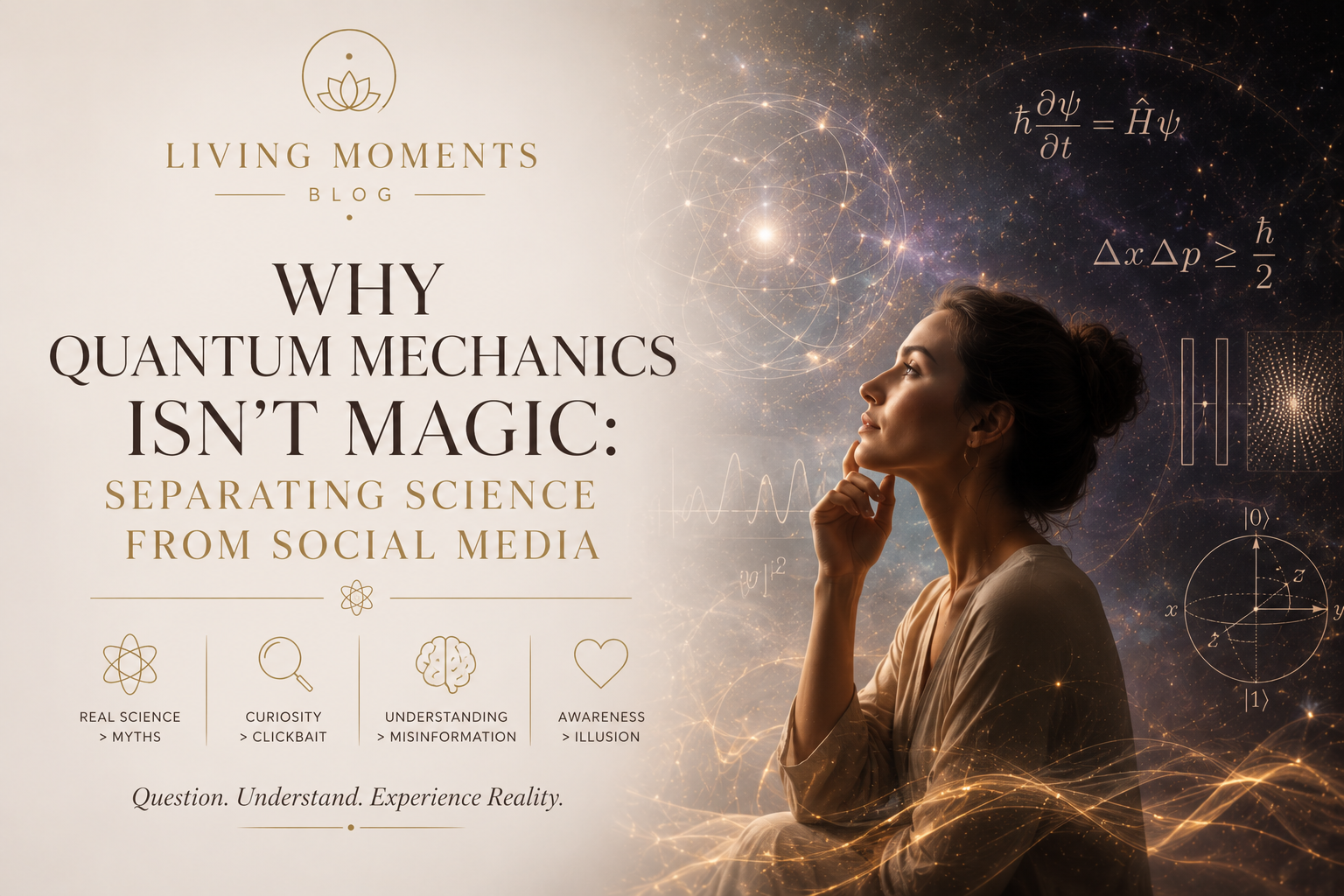
The truth is fascinating enough without turning science into mythology.
Scroll through social media for a few minutes and you’ll probably come across a video claiming that quantum physics proves manifestation, that your thoughts literally create reality, or that science has finally confirmed ancient spiritual beliefs.
These videos often receive millions of views.
They also leave many people wondering:
“Is this really what quantum physics says?”
The short answer is no.
Quantum mechanics is one of the most successful scientific theories ever developed—but much of what circulates online about it has little to do with the actual science.
Let’s separate evidence from exaggeration.
Why Quantum Physics Became So Popular Online
Quantum mechanics is genuinely strange.
Particles behave differently than everyday objects.
Light acts as both a wave and a particle.
Some events can only be predicted through probabilities.
Entangled particles exhibit correlations that seem almost unbelievable.
Because these ideas challenge our intuition, they’re easy to transform into dramatic stories.
Social media rewards content that surprises people.
Unfortunately, scientific nuance rarely goes viral.
Simple headlines like “Science proves your thoughts create reality” attract far more attention than careful explanations about probability amplitudes or quantum field theory.
What Quantum Mechanics Actually Studies
Quantum mechanics is the branch of physics that describes nature at extremely small scales.
It explains the behavior of:
- Electrons
- Photons
- Atoms
- Molecules
- Subatomic particles
It has allowed scientists to build technologies including:
- Computers
- Smartphones
- Lasers
- MRI scanners
- GPS systems
- Solar panels
- Modern electronics
These inventions exist because quantum mechanics makes incredibly accurate predictions.
Its success comes from experiments—not speculation.
Myth #1: “Your Thoughts Create Physical Reality”
This is probably the most common claim online.
The argument usually goes something like this:
Quantum particles respond to observation.
Humans observe reality.
Therefore, human thoughts create reality.
It sounds convincing until one important detail is added.
In physics, the word observation does not necessarily mean conscious awareness.
It refers to a physical interaction that transfers or records information, such as a particle interacting with another particle or with a measuring device.
A detector doesn’t need beliefs, emotions, or intentions to perform a measurement.
Neither does nature.
There is currently no experimental evidence showing that human thoughts alone change quantum outcomes.
Myth #2: “Quantum Physics Proves Manifestation”
Manifestation has become one of the internet’s favorite topics.
Some people present it as a psychological practice focused on goals, habits, and optimism.
Others claim it is directly supported by quantum mechanics.
This is where science and self-help often become mixed together.
Positive thinking can influence your behavior.
Your behavior can influence your decisions.
Your decisions can influence your future.
These are well-supported psychological ideas.
But this is very different from saying your thoughts alter quantum fields in ways that attract specific events into your life.
Modern physics does not support that conclusion.
Myth #3: “Scientists Have Proven Consciousness Controls the Universe”
Some interpretations of quantum mechanics have explored whether consciousness could play a role in measurement.
However, this remains a philosophical question—not an established scientific fact.
Today, most physicists explain quantum measurements without requiring human consciousness.
There is no scientific consensus that consciousness collapses the wave function or governs the behavior of the universe.
The mystery remains unsolved.
And that’s okay.
Science advances by asking questions, not by pretending to already have every answer.
Why These Myths Spread So Easily
Humans naturally look for meaning.
We enjoy stories that make us feel connected to something larger than ourselves.
Quantum mechanics offers mysterious language:
- Energy
- Frequency
- Waves
- Possibility
- Uncertainty
Outside of physics, these words often take on symbolic meanings.
There’s nothing wrong with using scientific ideas as metaphors—as long as we remember they’re metaphors.
The problem begins when metaphor is presented as established evidence.
Science Doesn’t Need to Be Magical to Be Amazing
One reason people add mystical explanations is because they think reality needs extra mystery to inspire wonder.
But the actual science is already astonishing.
Imagine trying to explain to someone 300 years ago that:
- Invisible particles can become entangled across great distances.
- Tiny electronic chips will contain billions of transistors.
- Light can carry information through glass fibers around the world.
- Computers will perform trillions of calculations every second because of quantum mechanics.
These achievements would have sounded like magic.
Yet they are the result of observation, experimentation, mathematics, and decades of careful research.
How to Evaluate Extraordinary Claims
Whenever you encounter a sensational claim about quantum physics online, ask yourself a few simple questions:
- Does it cite peer-reviewed scientific research?
- Is it explaining experiments or making philosophical interpretations?
- Are scientists in the field making this claim, or is it coming from influencers with no physics background?
- Does it clearly distinguish between evidence and personal belief?
Critical thinking doesn’t diminish curiosity.
It protects it.
Science and Spirituality Can Coexist
It’s entirely possible to appreciate both science and spirituality without confusing the two.
Science seeks explanations through observation, experimentation, and reproducible evidence.
Spirituality often explores meaning, purpose, personal growth, ethics, and inner experience.
These are different ways of understanding life.
Neither needs to replace the other.
Respecting their differences allows both to contribute something valuable.
Final Thoughts
Quantum mechanics is not magic.
It isn’t a shortcut to unlimited manifestation.
It doesn’t prove every inspirational quote shared online.
What it does offer is something far more enduring:
A glimpse into a universe that is astonishingly complex, deeply elegant, and still full of unanswered questions.
The greatest scientific discoveries didn’t happen because people stopped asking difficult questions.
They happened because people kept asking them—with curiosity, humility, and a commitment to evidence.
Perhaps that’s the most inspiring lesson quantum mechanics has to teach.
Not that reality bends to our wishes.
But that reality is extraordinary enough to keep exploring for a lifetime.
