
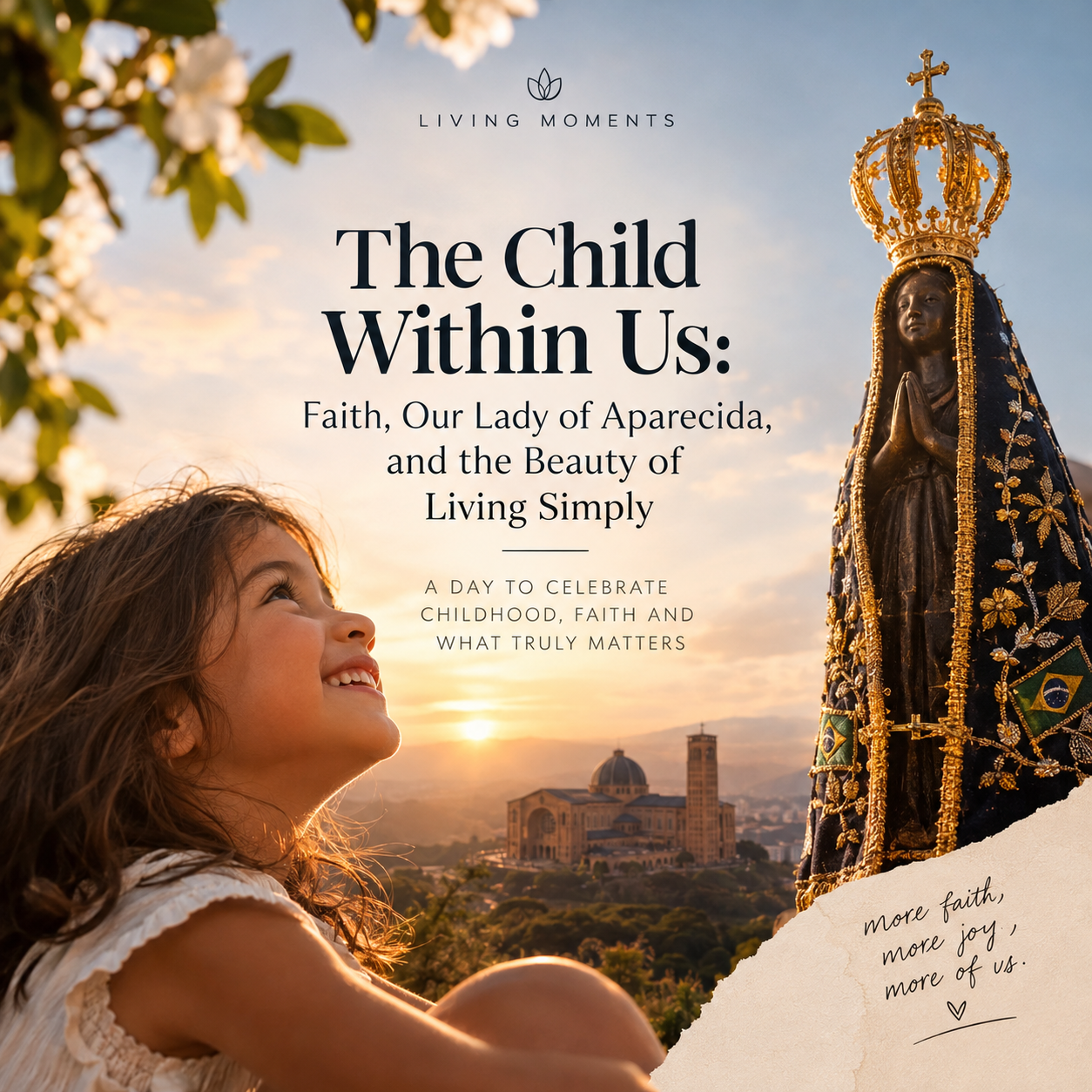
An October 12 reflection on childhood, spirituality, inner peace, and the courage to keep dreaming.
By Melina Moreno | Living Moments
October 12 is a special day in Brazil. It is a day of celebration, family, childhood, faith, and devotion to Our Lady of Aparecida, the country’s patron saint. For many Brazilians, it is a religious holiday, a day to spend time with children, and an opportunity to reconnect with the people and values that make life meaningful.
But beyond the celebrations, this day invites us to reflect on something much deeper: What if growing up does not have to mean losing the lightness, authenticity, and wonder we once carried so naturally?
What if, in the process of becoming adults, we have forgotten that we are still allowed to laugh freely, dream boldly, ask questions, feel deeply, and admit when we need someone to hold us?
Perhaps this October 12 can be more than a holiday. Perhaps it can be an invitation to return to ourselves.
Why Is October 12 Special in Brazil?
Brazil celebrates two important occasions on October 12: Children’s Day (Dia das Crianças) and the Feast of Our Lady of Aparecida (Nossa Senhora Aparecida).
Although they share the same date, they have different historical origins.
Children’s Day in Brazil
Children’s Day is a celebration of childhood, family, play, and the importance of protecting children’s well-being. It is a popular occasion for family gatherings, gifts, outdoor activities, and spending quality time together.
The date became established in Brazil during the twentieth century. Children’s Day was officially proclaimed in 1924, while its widespread popularity as a gift-giving celebration developed later.
Beyond presents and festivities, however, the day offers an opportunity to consider what childhood represents: curiosity, imagination, emotional honesty, spontaneity, and the freedom to explore the world without having every step figured out.
Children remind us that life does not always need to be complicated to be meaningful.
They can find happiness in a walk, a game, a story, a warm embrace, or the simple presence of someone they love.
As adults, we often spend so much time pursuing the next achievement that we forget how to appreciate what is already here.
Perhaps one of the most beautiful ways to celebrate Children’s Day is to ask ourselves whether we have preserved any of that original ability to experience life with wonder.
Our Lady of Aparecida: The Patron Saint of Brazil
October 12 is also the Feast of Our Lady of Aparecida, the Marian devotion deeply rooted in Brazilian Catholic faith.
According to the historical tradition of the devotion, in 1717, three fishermen—Domingos Garcia, João Alves, and Filipe Pedroso—were fishing in the Paraíba do Sul River near Guaratinguetá, in the state of São Paulo.
After struggling to catch fish, they retrieved a small terracotta statue of the Virgin Mary from the river, first finding its body and then its head. The statue represented Our Lady of the Immaculate Conception.
Tradition recounts that the fishermen subsequently experienced an extraordinary abundance of fish. The story became associated with divine grace, hope, and the beginnings of a devotion that would spread throughout Brazil.
The image became known as Nossa Senhora Aparecida, meaning Our Lady of Aparecida.
In 1930, Pope Pius XI officially proclaimed Our Lady of Aparecida the patroness of Brazil. In 1980, October 12 was established as a national public holiday in her honor.
Today, the National Shrine of Aparecida welcomes millions of pilgrims who come to pray, express gratitude, seek comfort, and renew their faith.
For many devotees, Mary represents maternal love, protection, compassion, humility, and the hope that accompanies us through life’s uncertainties.
You can learn more about her history through Vatican News and the National Shrine of Aparecida.
What Does the Bible Say About Children and Faith?
One important distinction deserves to be made: Our Lady of Aparecida is a Catholic devotion to Mary, the mother of Jesus. The Bible does not describe the discovery of her statue in Brazil or establish October 12 as her feast day. These belong to the history and religious traditions of Brazil.
However, the Bible offers meaningful reflections on childhood, humility, faith, love, and our relationship with God.
These teachings help us understand why the symbolism of Children’s Day can resonate so deeply with a spiritual celebration.
1. Becoming Like Children
In Matthew 18:3, Jesus teaches that people must become like little children to enter the kingdom of heaven.
This passage is not an invitation to become immature or irresponsible. Rather, it challenges us to reconsider pride, self-importance, and the desire to control everything.
Children can remind us of qualities that adults sometimes lose: openness, humility, curiosity, and the willingness to receive love without believing we must earn every bit of it.
As we grow older, we learn to protect ourselves. We become more cautious about what we say, how we appear, and how others might interpret our choices.
Sometimes, that protection becomes a mask.
We hide our sadness because we want to appear strong. We silence our dreams because we fear criticism. We change our personalities to fit into places where acceptance seems conditional.
But the spiritual invitation is not necessarily to return to childhood itself. It is to recover the qualities that allow us to approach life with humility and an open heart.
Perhaps growing spiritually means becoming more honest, not more perfect.
2. Let the Children Come
In Mark 10:14, Jesus says, “Let the little children come to me.”
The passage reminds readers of the importance Jesus places on welcoming children rather than dismissing or excluding them.
We can also reflect on the significance of being welcomed without having to prove our worth.
How often do we feel that we must achieve something before we deserve rest? That we must solve every problem before asking for help? That we must be useful, productive, or emotionally composed to deserve affection?
Love should not be reduced to a reward for performance.
Sometimes, the most meaningful thing we can offer another person is our presence. Sometimes, the most important thing we can allow ourselves to receive is the same.
3. Trusting God Without Having Every Answer
Proverbs 3:5–6 encourages believers to trust in the Lord rather than relying exclusively on their own understanding.
This does not mean abandoning responsibility, ignoring reality, or assuming that every event will unfold exactly as we wish.
Faith can coexist with uncertainty, practical decisions, and difficult emotions.
There are seasons when we do not understand why a door has closed, why a relationship has changed, why a plan has failed, or why a new beginning feels so uncomfortable.
We may have prayed for a different outcome. We may have worked hard and still found ourselves standing somewhere we never expected to be.
In those moments, faith can help us remain open to possibilities we cannot yet see.
Rather than interpreting every obstacle as proof that we have failed, we can pause, reflect, and ask what the present moment requires of us.
We do not need to know the entire road to take the next honest step.
And we do not need to pretend that uncertainty is easy in order to trust God through it.
The Child Within Us: Growing Up Without Losing Ourselves
As children, many of us dream freely.
We imagine the places we will visit, the people we will become, the adventures we will experience, and the lives we will create.
Our dreams often begin before we understand the expectations of society. Before we learn to compare ourselves with others. Before we believe that our worth depends on a particular career, relationship status, income, appearance, or lifestyle.
Then life happens.
We experience rejection, disappointment, responsibilities, financial pressure, and the opinions of others. We learn that being accepted sometimes seems easier when we adapt ourselves to what people expect.
Gradually, we may begin to confuse fitting in with belonging.
We become so concerned with being understood that we stop expressing ourselves honestly. We become so focused on appearing successful that we forget to ask whether our lives actually feel meaningful.
But there is a difference between growing up and abandoning ourselves.
Maturity can teach us discernment without taking away our curiosity. Responsibility can help us build a meaningful life without eliminating spontaneity. Experience can make us wiser without requiring us to become cynical.
The goal is not to remain a child forever.
It is to become an adult who has not forgotten how to feel wonder.
To dream with greater wisdom, love with greater awareness, and make decisions that honor both our responsibilities and our deepest values.
Perhaps today is an opportunity to remember the things that once made us feel alive—not because we must return to the past, but because some parts of ourselves deserve to accompany us into the future.
You Do Not Have to Be Strong All the Time
There is another lesson we often learn as we grow older: the expectation that we must handle everything alone.
We learn to say, “I’m fine,” even when we are exhausted.
We reassure everyone around us while quietly wondering where we can go to feel safe ourselves.
We become accustomed to solving problems, supporting others, and moving forward, sometimes without acknowledging how much we are carrying.
But strength does not mean the absence of vulnerability.
You can be independent and still need affection. You can have faith and still experience fear. You can be grateful for your life and still feel overwhelmed by it.
You can believe that everything will eventually make sense and still wish that someone would sit beside you while it does not.
There is nothing shameful about needing another person’s presence.
Sometimes, what we need is not advice, a solution, or a reminder to be positive. We need someone who will listen without judging, offer a sincere embrace, and allow us to express what we have been holding inside.
Perhaps that person can only be there for a short time. Perhaps the conversation lasts one evening, or the embrace comes during a difficult season.
Even then, it can matter.
A moment of genuine connection can remind us that the world is not entirely made of demands, expectations, and responsibilities. There is still kindness. There are still people willing to listen. There is still room to be human.
And when we have the opportunity, we can become that safe place for someone else.
We were never meant to prove our strength every minute of every day. Sometimes, strength is allowing ourselves to be held.
The Psychology of Authenticity: Why We Wear Masks
From a psychological perspective, the desire to belong is a natural part of being human.
We depend on relationships, connection, and a sense of acceptance. We learn social rules and adapt our behavior to different environments. These abilities can help us cooperate, communicate, and live alongside others.
The difficulty begins when adaptation becomes self-abandonment.
When we constantly suppress our feelings, opinions, interests, or needs to avoid disapproval, we may gradually lose touch with what we genuinely value.
Psychologist Carl Rogers emphasized the importance of congruence: the relationship between our inner experience and the way we present ourselves to the world.
When our external behavior consistently contradicts our internal experience, we can feel disconnected from ourselves.
For example, we may say yes when we want to say no. We may remain in situations that diminish us because we fear disappointing someone. We may pursue a version of success that impresses others but leaves us feeling empty.
Learning to recognize these patterns can help us make more intentional choices.
This does not mean expressing every thought without considering its consequences. Authenticity is not an excuse to disregard other people. Rather, it means finding ways to live honestly while respecting ourselves and others.
A useful question to ask is:
Am I choosing this because it reflects who I am, or because I am afraid of who I might become in someone else’s eyes?
We do not need to answer immediately. Sometimes, simply asking the question begins a process of self-understanding.
And self-understanding takes time.
A Neuroscience Perspective: Why Small Moments Matter
Our brains are shaped by experience, learning, relationships, and repeated patterns of behavior.
Over time, we develop habits of attention and response. We may become accustomed to anticipating criticism, prioritizing other people’s needs, or interpreting uncertainty as a threat.
These patterns are not permanent definitions of who we are. With practice and new experiences, we can learn different ways of responding.
Small moments of joy, meaningful connection, rest, and attention to our surroundings can contribute to emotional well-being. They do not erase serious problems, but they can become part of a healthier relationship with everyday life.
Consider what happens when we slow down enough to notice something simple: sunlight entering a room, the sound of rain, a conversation with someone we love, or the feeling of being outdoors without rushing toward another destination.
We may discover that our attention has been so focused on what is missing that we have overlooked what is already present.
Gratitude does not require us to deny pain. We can acknowledge disappointment and still recognize moments of beauty.
We can want a different future while appreciating the life we are living today.
And we can pursue our dreams without treating the present as merely an obstacle to overcome.
Sometimes, living more fully begins with learning to pay attention.
How to Celebrate October 12 With More Meaning
Whether you celebrate through Catholic faith, family traditions, or personal reflection, this holiday can become an opportunity to reconnect with what matters.
You do not need an elaborate plan or an expensive experience. Often, the simplest activities create the space we need to feel present.
1. Begin the Day With Prayer or Silence
Before reaching for your phone, give yourself a few quiet minutes.
If you are Catholic, you might pray to Our Lady of Aparecida, attend Mass, say the Rosary, or offer a prayer of gratitude for your family and the people who have supported you.
You can also read a short passage from the Bible, such as Matthew 18:1–5, Mark 10:13–16, or Proverbs 3:5–6.
If you do not follow a particular religion, you can use this time for meditation, journaling, or quiet reflection.
Ask yourself what you need to release, what you want to nurture, and what deserves more of your attention.
You do not have to arrive at an answer. Sometimes, a few moments of stillness are enough.
2. Spend Time With Children—and Listen to Them
If children are part of your life, spend time with them without turning every moment into a lesson.
Play a game, draw together, prepare a meal, tell stories, or explore somewhere outdoors.
Let them ask questions. Allow them to be curious. Notice what makes them laugh.
Children’s Day is also a reminder that children deserve much more than gifts. They need safety, affection, respect, opportunities to learn, and adults who take their feelings seriously.
If you do not have children nearby, consider supporting a local initiative that helps children and families, provided you can do so safely and within your means.
3. Revisit a Dream You Have Put Aside
Take a notebook and remember the things you wanted to do before you became concerned with whether they were realistic, impressive, or acceptable to other people.
Perhaps you wanted to travel, learn an instrument, write a book, live closer to nature, create something with your hands, or build a life with more freedom.
You do not have to pursue every childhood dream exactly as you once imagined it.
Some dreams will change as you grow. Others may no longer fit the person you have become.
But a few might still contain something important about your values.
Choose one small step you can take toward a meaningful goal. It could be writing one paragraph, researching a destination, taking a walk, or making time for a creative practice.
Let your dreams inspire you without turning them into another source of pressure.
4. Spend Time in Nature
Take a walk in a park, visit a beach, explore a trail, or sit beneath a tree.
Leave yourself some room to notice your surroundings rather than treating the experience as another task to complete.
Nature can offer an opportunity to slow down, move your body, and reconnect with the present moment.
You do not need to travel far to experience this. A quiet street, a garden, or an open window can be enough to begin.
If you are spending the day with family or friends, invite them to join you.
Sometimes, the best memories are created when nobody is trying too hard to make something memorable.
5. Reach Out to Someone Who Might Need You
Send a message to a friend you have not spoken to in a while.
Call a family member. Ask someone how they are really doing, and give them enough time to answer.
If a person you love is going through a difficult season, remember that you do not need to have the perfect words.
You can simply say, “I’m here if you need someone to listen.”
And if you are the person who needs support today, consider reaching out to someone you trust.
You do not have to wait until things become unbearable before asking for company.
6. Do Something That Makes You Feel Like Yourself
Dance in your living room. Listen to a song you loved years ago. Cook a meal that reminds you of home. Practice yoga, read, paint, write, or watch a film that makes you feel something meaningful.
Give yourself permission to enjoy an activity without needing to turn it into a business, a personal achievement, or content for social media.
Not every beautiful moment needs to be documented.
Some experiences are valuable precisely because they belong only to you.
7. Practice Gratitude Without Pretending Everything Is Perfect
At the end of the day, write down three things you appreciate.
They can be significant or ordinary: a person who stayed, a lesson you learned, a meal you enjoyed, a moment of courage, or the opportunity to begin again.
Then acknowledge one thing that has been difficult.
You can be grateful and disappointed at the same time. You can love your life and still want it to change.
Gratitude is not about convincing yourself that everything is wonderful. It is about making room to recognize what is good without denying what hurts.
A Simple Reflection for October 12
If you would like to make this holiday more personal, take a few minutes to answer these questions in your journal:
- When was the last time I felt completely free to be myself?
- What did I love doing as a child that I have forgotten about?
- Which expectations am I carrying that no longer reflect my values?
- Where in my life do I feel the need to appear strong when I actually need support?
- Who makes me feel safe enough to be honest?
- What dream still deserves a place in my future?
- What simple thing could I appreciate more often?
Write without worrying about making your answers sound beautiful or profound.
You do not need to share them with anyone. The purpose is simply to listen to yourself with the same patience you might offer someone you love.
A Prayer for Peace, Faith, and a Lighter Heart
On this day, we can turn our attention toward the things that matter most: the lives we have been given, the people who walk beside us, the lessons that have shaped us, and the possibility of beginning again.
If prayer is part of your life, you might offer these words in your own way:
Dear God,
Thank You for the gift of life, for the people who love us, and for the opportunities we receive to grow, learn, and begin again.
On this day dedicated to children and Our Lady of Aparecida, help us recover the lightness we sometimes lose as we grow older.
Teach us to laugh without fear, to live with authenticity, to dream without being imprisoned by the expectations of others, and to appreciate the beauty hidden in ordinary moments.
Through the example of Mary, may we remember the importance of humility, compassion, and trust. When we cannot understand the road ahead, help us find the courage to take the next step with faith and wisdom.
Please remind us that we do not need to be strong all the time. Give us the humility to ask for help, the courage to express what we feel, and the generosity to become a source of comfort for those who need us.
Protect the children of this world. May they grow up surrounded by love, safety, dignity, and the freedom to discover who they are.
And as we grow older, help us protect the child within us—the part that still hopes, wonders, creates, and believes that life can be beautiful.
Today, we ask for peace, tranquility, and happiness. Not a perfect life without difficulties, but hearts capable of finding peace even when the answers have not yet arrived.
May we never lose our faith, our compassion, or our ability to recognize the goodness that still exists around us.
Amen.
Final Thoughts: May We Never Forget the Child We Once Were
Perhaps the greatest lesson of Children’s Day is not that we should try to become children again.
It is that growing older should not require us to abandon everything that made us feel alive.
We can become more responsible without becoming rigid. We can learn from disappointment without losing hope. We can pursue meaningful ambitions without allowing them to consume every quiet moment of our lives.
We can be strong and still ask for help.
We can trust God while admitting that we do not understand everything.
We can build a future without forgetting to appreciate the present.
And we can allow ourselves to be imperfect, vulnerable, curious, and real.
This October 12, may we remember the dreams that began before the world taught us to doubt ourselves. May we appreciate the people who offer us a safe place to land. May we learn to recognize love not only in grand gestures, but also in ordinary moments of kindness.
May we be gentle with ourselves and with the people around us.
And may we never forget that we do not have to earn the right to experience joy, rest, connection, or peace.
Sometimes, the most meaningful way forward is to return to what has always mattered.
To faith. To love. To simplicity. To the courage to be ourselves.
To the quiet understanding that even when the road feels uncertain, we can keep walking without knowing every answer.
And perhaps, somewhere along the way, we will discover that the life we were searching for does not require us to become someone else.
Perhaps it begins when we finally allow ourselves to be who we are.
Today, I pray for peace, tranquility, and happiness. May God and Our Lady of Aparecida guide us, and may we never lose the light that once made the world feel full of possibilities.
Happy Children’s Day and Feast of Our Lady of Aparecida. 🤍
May we grow in wisdom without losing our wonder, and may we never be afraid to let love find us when we need it most.
— Melina Moreno
Living Moments
Further Reading
For readers who would like to explore the history and spiritual meaning of this Brazilian holiday:
- Vatican News — Our Lady of Aparecida
- National Shrine of Aparecida — Official Website
- Matthew 18 — The Greatest in the Kingdom of Heaven
- Mark 10 — Jesus and the Children
- Proverbs 3 — Trust in the Lord
Suggested SEO Details
SEO title: Children’s Day in Brazil: Faith, Our Lady of Aparecida, and the Child Within Us
Meta description: Discover the meaning of October 12 in Brazil, the story of Our Lady of Aparecida, biblical reflections on childhood and faith, and simple ways to reconnect with joy, authenticity, and inner peace.
Suggested URL slug: childrens-day-brazil-our-lady-of-aparecida
Focus keywords: Children’s Day in Brazil, Our Lady of Aparecida, October 12 Brazil, inner child, faith and self-discovery, biblical reflections on childhood, finding inner peace.
Suggested categories: Spirituality, Self-Discovery, Mindful Living, Philosophy & Well-Being.
