
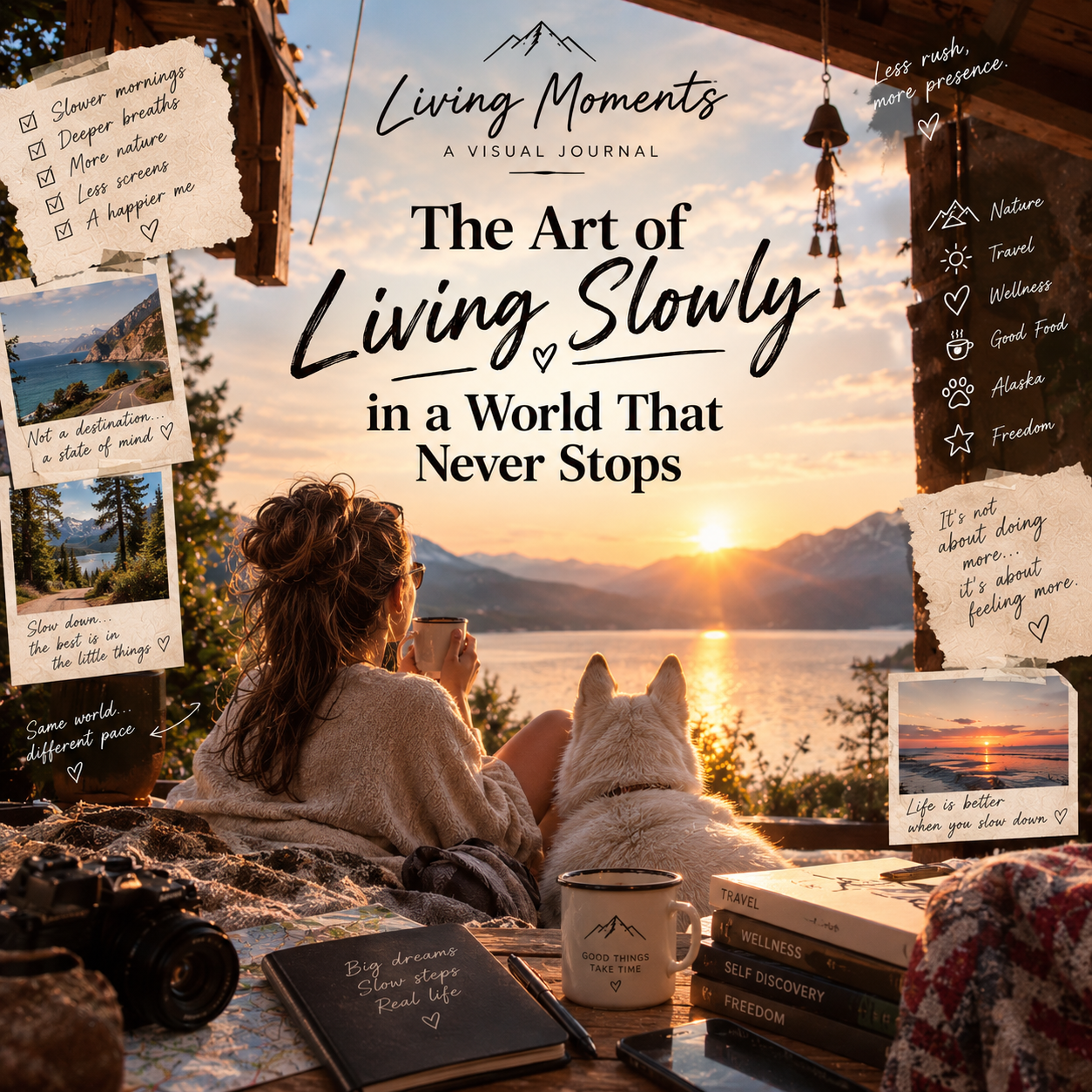
Wellness & Slow Living | Living Moments
There is a strange kind of pressure in modern life.
The pressure to answer quickly.
To move faster.
To do more.
To become more.
To always be building, growing, improving, producing.
The world often rewards speed. It celebrates busy schedules, packed calendars, constant notifications, endless ambition, and the idea that if you slow down, you might somehow fall behind.
But behind all the noise, many of us are quietly asking a different question:
What if life was never meant to feel like a race?
What if presence matters more than productivity?
What if rest is not laziness?
What if softness is strength?
What if a meaningful life is not created by doing more—but by learning how to truly be where you are?
Living slowly is not about escaping reality.
It is not about avoiding ambition or refusing growth.
Slow living is an intentional choice.
It is choosing to move through life with awareness.
To feel your own rhythm.
To notice what matters.
To create space for your body, your mind, your creativity, and your relationships to breathe.
And in a world that constantly tells us to rush—
choosing slowness can feel revolutionary.
Why We Feel So Rushed All the Time
Many of us grew up believing that success means being busy.
If your calendar is full, you must be doing something right.
If you are constantly productive, you must be getting ahead.
If you rest too much, maybe you are wasting time.
Social media adds another layer.
We scroll and instantly compare:
someone launching something new, traveling, getting engaged, moving cities, buying homes, building businesses, posting highlight after highlight.
Even beautiful things can start feeling like pressure when we believe we should be doing everything all at once.
The result?
We feel overstimulated.
Disconnected from ourselves.
Mentally tired.
Emotionally overwhelmed.
Present in body—but somewhere else in our minds.
And often the first thing we lose is our connection with the moment we are actually living.
The morning coffee becomes rushed.
The walk becomes another task.
The conversation becomes something we half-hear while thinking about what’s next.
We are physically here—but emotionally already in tomorrow.
And that creates a quiet exhaustion many people carry without even realizing it.
Slow Living Is Not About Doing Less—It’s About Feeling More
Slow living gets misunderstood.
People imagine it means moving to the countryside, deleting every app, and living a perfectly aesthetic life surrounded by candles and linen.
And while those things can feel beautiful…
slow living is much deeper than aesthetics.
It is learning how to become present enough to actually experience your own life.
It looks like:
– drinking coffee without multitasking
– walking without checking your phone every two minutes
– finishing a meal and actually tasting it
– saying no without guilt
– creating space in your week without needing to “earn” it
– listening to your body before burnout forces you to stop
– choosing quality over quantity
– noticing joy in ordinary moments
Slow living is not about perfection.
It is about intention.
It asks:
What feels aligned for me right now?
What actually matters today?
Where am I rushing unnecessarily?
What am I trying to prove?
Can I trust my own pace?
Those questions change everything.
The Nervous System Needs Slowness Too
There is also something beautifully practical about slowing down.
Your nervous system was never designed to operate in constant alert mode.
Notifications.
Screens.
Traffic.
Deadlines.
Comparison.
Information overload.
Our brains receive more stimulation in one day than previous generations often processed in much longer stretches of time.
That matters.
Because when the body stays in survival mode for too long, we stop feeling grounded.
We become reactive instead of intentional.
We feel mentally scattered.
Rest doesn’t feel restorative.
Creativity feels blocked.
Even simple joy can feel harder to access.
Creating slower moments during the day helps signal safety back to the body.
That can be as simple as:
– opening a window and breathing deeply for two minutes
– stretching before looking at your phone
– journaling before bed
– cooking without rushing
– spending ten quiet minutes outside
– listening to music with full attention
– lighting a candle and creating a small ritual around your evening
Small moments matter.
The body remembers how safety feels.
And the more often you return to presence, the easier it becomes to feel grounded again.
The Beauty of Romanticizing Ordinary Life
One of the most healing parts of slow living is learning how to appreciate ordinary moments again.
Not every meaningful memory happens during a huge milestone.
Some of the most beautiful parts of life feel surprisingly simple:
fresh sheets after a long day
sunlight on your kitchen table
a quiet neighborhood walk
the smell of rain
writing your thoughts in a notebook
hearing laughter in the next room
traveling slowly and noticing the details
a homemade meal
watching the sky change colors
These moments feel small.
But often they become the memories we carry the longest.
A slower life teaches us that beauty does not always need a dramatic setting.
Sometimes beauty is simply attention.
And attention is a form of love.
When you pay attention to your own life—you experience it more deeply.
Practical Ways to Slow Down (Even With a Busy Life)
Slow living does not require a perfect routine.
You can start exactly where you are.
Here are gentle ways to begin:
1. Start your morning without urgency
Even five intentional minutes helps.
Before opening notifications:
drink water, breathe, stretch, sit in silence.
Give your mind a chance to arrive before the world starts asking things from you.
2. Create white space in your calendar
Not every hour needs to be productive.
Leave room.
For breathing.
For rest.
For spontaneous joy.
For nothing.
Nothing is often where creativity returns.
3. Practice single-tasking
Do one thing fully.
Eat while eating.
Walk while walking.
Read while reading.
Presence grows when attention becomes simpler.
4. Protect your energy
Say yes less automatically.
Ask yourself:
Do I actually want this?
Does this feel aligned?
Will this nourish me—or drain me?
Boundaries create spaciousness.
5. Spend time in nature
Nature moves slowly.
Trees do not rush growth.
The ocean does not force timing.
Sunsets never compete.
Nature reminds us that seasons matter.
And so do ours.
6. Celebrate enough
You do not need to chase every next thing.
Sometimes enough is already beautiful.
Enough peace.
Enough progress.
Enough softness.
Enough joy.
That mindset changes the nervous system—and the heart.
You Are Allowed to Move at Your Own Pace
This may be the hardest part.
Trusting your pace.
Especially when everyone around you seems to be moving differently.
Someone may be ahead in career.
Someone else may be traveling more.
Someone else may be starting over.
Someone may look like they have everything figured out.
But your timing belongs to you.
Growth does not need to look impressive to be real.
Healing can be quiet.
Transformation can happen slowly.
A meaningful life can feel soft.
A beautiful life can be simple.
And sometimes the most powerful thing you can do is stop rushing long enough to notice:
you are already living moments worth remembering.
Not someday.
Not after everything becomes perfect.
Not after you finally catch up.
Now.
This morning.
This season.
This version of you.
This ordinary beautiful life.
Slow enough to feel it.
Present enough to receive it.
Soft enough to enjoy it.
That may be the art of living after all.
Living Moments reminder:
You do not need to rush your becoming.
You are allowed to move slowly.
You are allowed to choose presence over pressure.
And you are allowed to create a life that feels beautiful from the inside—not only one that looks beautiful from the outside. ✨
— Living Moments
