
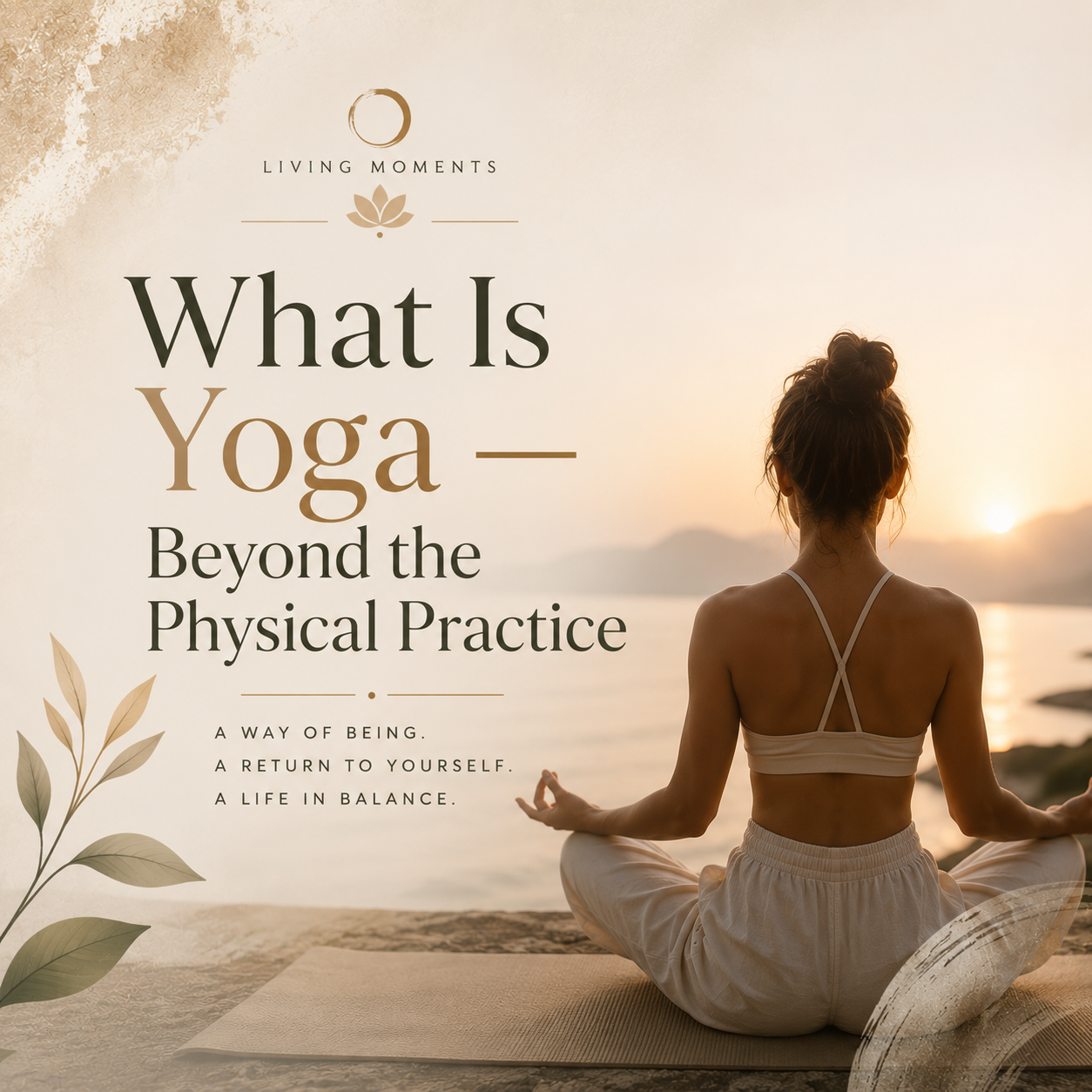
Yoga is often misunderstood as only stretching, flexibility, or aesthetic poses.
But yoga is much deeper than movement.
The word “Yoga” comes from the Sanskrit root Yuj, which means:
- union,
- integration,
- connection.
Originally developed thousands of years ago in ancient India, yoga was created as a system to harmonize:
- body,
- mind,
- breath,
- emotions,
- awareness,
- and consciousness.
The goal was never only physical fitness.
The deeper purpose of yoga is inner balance and liberation from suffering caused by mental agitation, attachment, fear, and disconnection.
Yoga Is Not a Religion
One of the biggest misconceptions about yoga is believing it belongs to a specific religion.
Yoga is a philosophy and a practice of self-awareness.
People from different religions — or no religion at all — practice yoga around the world.
Traditional yoga explores:
- consciousness,
- emotional regulation,
- breath,
- ethics,
- nervous system balance,
- meditation,
- mindfulness,
- and connection between body and mind.
It does not require worshipping any deity.
For many people, yoga becomes:
- therapy,
- emotional healing,
- nervous system regulation,
- self-knowledge,
- and inner peace.
The 8 Limbs of Yoga (Ashtanga)
Classical yoga was organized in the Yoga Sutras by the sage Patanjali.
This path became known as the 8 Limbs of Yoga (Ashtanga).
1. Yamas — Ethical Principles
How we relate to the world.
Examples:
- Ahimsa → non-violence
- Satya → truthfulness
- Aparigraha → non-attachment
- Asteya → non-stealing
These principles help reduce mental suffering and emotional chaos.
2. Niyamas — Self-Discipline
How we relate to ourselves.
Examples:
- Saucha → purity
- Santosha → contentment
- Tapas → discipline and inner fire
- Svadhyaya → self-study
- Ishvara Pranidhana → surrender and trust
What Is Tapas?
Tapas is one of the most important concepts in yoga.
It means:
- discipline,
- consistency,
- transformation through conscious effort.
Not punishment.
Not toxic productivity.
True tapas is the ability to continue caring for yourself even when motivation disappears.
Sometimes tapas is:
- waking up to meditate,
- choosing silence,
- healing emotional patterns,
- breathing instead of reacting,
- staying present during discomfort.
3. Asana — Physical Postures
This is the most known part of yoga.
Originally, postures were created to prepare the body for meditation.
Common Sanskrit Names of Postures
- Tadasana → Mountain Pose
- Balasana → Child’s Pose
- Adho Mukha Svanasana → Downward Dog
- Vrikshasana → Tree Pose
- Virabhadrasana → Warrior Pose
- Savasana → Resting Pose
Each posture affects:
- muscles,
- circulation,
- breathing,
- hormones,
- and the nervous system.
4. Pranayama — Breath Control
“Prana” means life-force energy.
“Yama” means regulation.
Breathing practices are essential in yoga because breath directly affects the nervous system.
Slow breathing can help:
- reduce anxiety,
- regulate heart rate,
- calm emotional reactivity,
- improve focus,
- and activate the parasympathetic nervous system.
5. Pratyahara — Withdrawal of the Senses
A state where attention stops being constantly pulled by external stimulation.
Modern life overstimulates the brain continuously.
Pratyahara teaches:
less distraction,
more awareness.
It is one reason yoga feels mentally restorative.
6. Dharana — Concentration
The practice of sustained focus.
Training the mind to stay present instead of constantly wandering.
7. Dhyana — Meditation
Meditation in yoga is not “stopping thoughts.”
It is observing thoughts without becoming trapped by them.
This state creates mental clarity and emotional regulation.
8. Samadhi — State of Union
The deepest state in yoga.
What Is Samadhi?
Samadhi is described as:
- profound inner peace,
- expanded awareness,
- deep connection,
- absence of ego identification,
- total presence.
Not escapism.
Not unconsciousness.
But a state where the mind becomes quiet enough for awareness itself to emerge clearly.
Many traditions describe Samadhi as the ultimate purpose of yoga.
Yoga and Science
Modern science increasingly supports many benefits traditionally described by yoga practitioners.
Studies show yoga may help:
- reduce cortisol (stress hormone),
- improve sleep quality,
- decrease anxiety symptoms,
- improve flexibility and mobility,
- regulate breathing,
- improve emotional resilience,
- support vagus nerve activation,
- improve heart health,
- and reduce chronic stress.
Research in neuroscience also shows meditation and breathwork may positively affect:
- emotional regulation,
- attention,
- neuroplasticity,
- and stress response systems.
Yoga is now widely integrated into:
- psychology,
- trauma recovery,
- sports recovery,
- physical therapy,
- and wellness medicine.
Yoga Is More Than Flexibility
Yoga is not about performing perfect poses.
Some of the deepest yoga practices are invisible.
Learning to:
- breathe during discomfort,
- observe emotions,
- slow down,
- detach from expectations,
- regulate reactions,
- and become more conscious.
That is yoga too.
The Different Dimensions of Yoga
Yoga works on multiple levels simultaneously.
Physical
- posture,
- flexibility,
- mobility,
- strength,
- circulation.
Breath
- respiratory awareness,
- nervous system regulation,
- energy balance.
Mental
- focus,
- mindfulness,
- emotional awareness,
- stress reduction.
Emotional
- processing emotions,
- reducing reactivity,
- creating inner stability.
Spiritual
Not necessarily religious.
But connected to meaning, awareness, and inner connection.
Yoga Is a Practice of Returning
Returning to:
- the breath,
- the body,
- the present moment,
- awareness,
- and balance.
In a world built on overstimulation and urgency, yoga teaches something revolutionary:
slowness,
presence,
and conscious living.
Create your own rituals at home with:
🕯️ Living Moments Candle Shop
Coconut wax candles designed to bring warmth, calm, softness, and emotional comfort into your space.
🥣 Yogateria
Healthy desserts and cozy treats for your mindful evenings.
Use coupon code YOGASSE10 for 10% OFF on the entire website.
💪 Black Skull Supplements — Cupom 10% OFF LivingMoments
Support your wellness journey, energy, focus, recovery, and body balance through intentional supplementation.
