
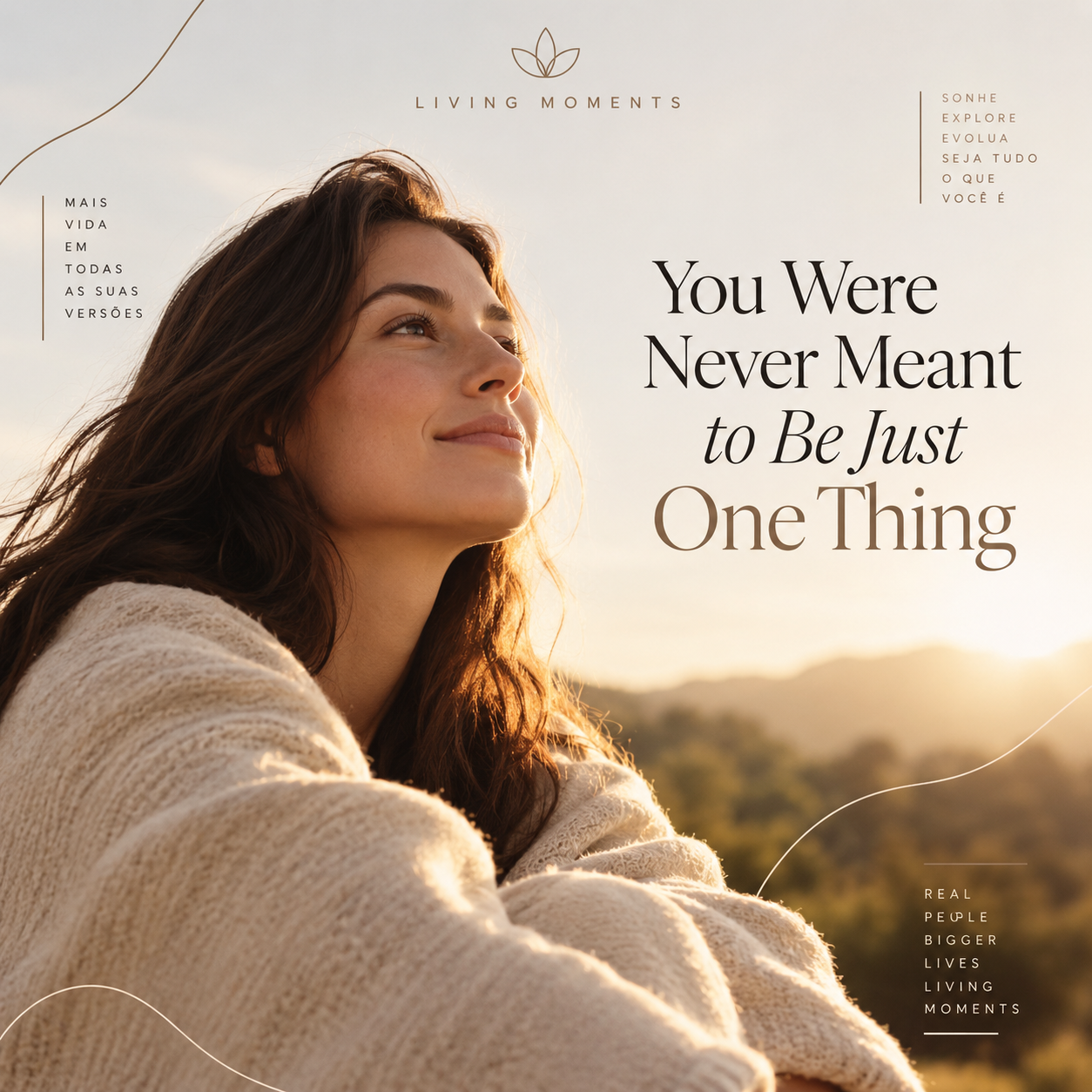
Perhaps the healthiest way to live is not to choose one version of yourself — but to remain curious enough to keep discovering who you are.
We live in a world that constantly asks us to define ourselves.
What do you do?
What is your talent?
What is your sport?
What are you good at?
What is your purpose?
And, somehow, we learn to believe that a meaningful life requires one clear answer.
One profession.
One passion.
One body.
One lifestyle.
One identity.
But what if we were never meant to be just one thing?
What if some people were not born with a single gift, but with a capacity to experience many?
What if the purpose is not always hidden inside one extraordinary talent waiting to be discovered?
What if sometimes, purpose is discovered through experimentation?
Look at a child.
A child does not begin life asking, “What is my one true calling?”
They play.
They run.
They dance.
They climb.
They draw.
They sing.
They swim.
They build things.
They destroy them.
They try again.
They become fascinated by something and then abandon it two weeks later.
And we don’t usually call that confusion.
We call it childhood.
We understand that a child needs to experience the world before knowing what they love.
Yet somewhere along the way, adults are expected to stop experimenting.
At a certain age, we are supposed to choose.
Choose a career.
Choose a sport.
Choose a lifestyle.
Choose an identity.
And once we choose, we are often encouraged to remain there.
But perhaps growing up should not mean losing our curiosity.
Perhaps maturity is learning how to experiment consciously.
You Are More Than Your Strongest Talent
You can love strength training and yoga.
You can enjoy running and still want to dance.
You can be fascinated by nutrition without wanting to become a nutritionist.
You can love business and art.
You can be analytical and deeply intuitive.
You can be ambitious and still crave a slow life.
You can love traveling and also want a home.
You can enjoy solitude and deeply value community.
You can be disciplined without becoming rigid.
You can be passionate without turning your passion into an obsession.
There is a difference between having a gift and being only your gift.
A gift is something you carry.
It is not necessarily the entirety of who you are.
And perhaps one of the most beautiful things about being human is that we are capable of developing.
We are not finished products.
We are constantly becoming.
Life Is an Experiment
We often speak about finding our purpose as if it were a hidden object.
As if somewhere inside us there is one answer.
This is what you were born to do.
But life rarely works that way.
Sometimes you discover yourself by doing something.
Then you discover that you don’t want it.
Sometimes you enter a new environment and discover a part of yourself that had never had space before.
Sometimes you try a sport and realize that your body loves it.
Sometimes you stop doing something and realize how much better you feel.
Sometimes you meet someone who introduces you to an entirely different way of seeing life.
Sometimes you move somewhere and become a different version of yourself.
And sometimes you return to something you once loved — but now experience it completely differently.
That is not failure.
That is information.
Every experience teaches you something about yourself.
Life becomes a continuous process of observation:
What gives me energy?
What drains me?
What makes me feel alive?
What makes my body feel stronger?
What makes my mind quieter?
What makes me more present?
What makes me more compassionate?
What makes me feel like myself?
This is experimentation.
And perhaps this is also one of the ways we discover purpose.
The Problem With 8 or 80
There is another lesson hidden here:
extremes are exhausting.
We have become very comfortable with extremes.
Train every day.
Don’t train at all.
Eat perfectly.
Eat without limits.
Work constantly.
Quit everything.
Be extremely disciplined.
Reject all discipline.
Be productive.
Escape productivity.
Become obsessed with wellness.
Reject wellness altogether.
But the body does not necessarily thrive in extremes.
Neither does the mind.
Health requires adaptation.
The body needs challenge, but it also needs recovery.
It needs movement, but it also needs rest.
It needs nourishment, but it also needs flexibility.
It needs strength, but it also needs mobility.
It needs stimulation, but it also needs periods of quiet.
It needs routine, but it also needs variation.
And this principle extends far beyond exercise.
It is a way of living.
Your Body Was Designed to Adapt
Medicine has taught us something profoundly important about the human body:
the body responds to what we repeatedly ask of it.
Training creates adaptation.
But adaptation also depends on recovery.
A stimulus without adequate recovery can become excessive stress.
And doing the exact same movement, at the same intensity, without allowing the body to recover or develop other physical qualities, is not necessarily the definition of health.
This is why modern exercise science emphasizes different components of physical fitness — strength, cardiovascular fitness, mobility, balance, coordination, power and recovery.
The goal is not simply to become extremely good at one movement.
The goal is to create a body capable of living.
A body capable of carrying you through different seasons.
A body that can walk, lift, bend, climb, rest, play, travel, explore and age with resilience.
There is nothing wrong with specialization.
Athletes often need it.
But there is a difference between training for a specific performance goal and believing that your entire physical life needs to revolve around one activity.
Your body is an ecosystem.
And ecosystems thrive through interaction, adaptation and diversity.
Even Food Can Become an Extreme
The same philosophy applies to nutrition.
Food is not supposed to become a moral battlefield.
We don’t need to divide the world into:
good foods and bad foods.
clean foods and dirty foods.
perfect days and ruined days.
Your body is not a punishment system.
Eating something indulgent does not make you a bad person.
Eating nutritious food does not make you morally superior.
And eating beyond what your body needs does not mean you need to punish yourself afterward.
Nutrition is more complex than that.
Your body needs nourishment.
It needs nutrients.
It needs enough energy.
It needs variety.
It needs consistency.
And it also exists within a real human life — birthdays, restaurants, celebrations, travel, family dinners, cultural traditions and spontaneous moments.
Health cannot be reduced to perfection.
The deeper question becomes:
Can you learn to listen?
Can you recognize hunger?
Can you recognize fullness?
Can you notice how different foods affect your energy and digestion?
Can you nourish yourself without fear?
Can you enjoy food without guilt?
Can you make choices without turning every decision into a judgment about your worth?
That is a much more sustainable form of health.
Yoga Was Never Only About Beautiful Postures
This is where yoga becomes much deeper than the image we often see online.
Yoga is frequently reduced to beautiful bodies, difficult poses and perfect flexibility.
But classical yoga contains an entire philosophy of how to live.
One of its foundational ethical principles is ahimsa — non-violence.
And perhaps ahimsa can completely change the way we relate to our bodies.
What if non-violence also meant:
Not forcing your body beyond what it can safely handle.
Not punishing yourself with exercise.
Not using food as a reward or punishment.
Not speaking to yourself with cruelty.
Not turning discipline into self-hatred.
Not comparing your body to someone else’s.
Not believing that exhaustion is always proof of progress.
Not confusing pain with virtue.
Yoga teaches us to pay attention.
To breathe.
To observe.
To find steadiness.
To recognize when we are forcing.
To recognize when we are resisting.
And eventually, to understand that effort and surrender can coexist.
There is effort.
And there is release.
There is strength.
And there is softness.
There is discipline.
And there is acceptance.
There is movement.
And there is stillness.
The practice is not choosing one side.
The practice is learning when each one is needed.
The Art of Flow
Perhaps this is what it means to bring yoga off the mat.
You begin to understand that life also has an asana.
Sometimes you move forward.
Sometimes you pause.
Sometimes you hold.
Sometimes you release.
Sometimes you need strength.
Sometimes you need flexibility.
Sometimes you need to breathe through discomfort.
Sometimes you need to leave the posture entirely.
And sometimes the posture that was right for you yesterday is no longer right for you today.
That doesn’t mean yesterday was wrong.
It means you changed.
This is one of the great lessons of embodiment:
the body gives us feedback.
We learn to notice tension.
Fatigue.
Excitement.
Restlessness.
Lightness.
Resistance.
Ease.
And instead of immediately judging those sensations, we can become curious about them.
What is my body telling me?
This doesn’t mean every sensation is a command.
Pain does not always mean “stop forever.”
Fatigue does not always mean “rest forever.”
Anxiety does not always mean “this is wrong.”
Pleasure does not always mean “this is right.”
Listening to yourself requires discernment.
It is not impulsiveness.
It is not doing whatever feels easiest.
It is developing a relationship with yourself strong enough to hear the difference.
Every Person Is a Universe
There is no universal formula for being human.
What works beautifully for one person may not work for another.
One person may flourish with running.
Another may find freedom in lifting weights.
Another may discover peace through swimming.
Another through hiking.
Another through dance.
Another through yoga.
Another may need a combination of several forms of movement.
And even the same person can need completely different things at different stages of life.
This is why comparison can become so destructive.
You are looking at another person’s body, another person’s nervous system, another person’s history, another person’s responsibilities, another person’s genetics, another person’s environment, another person’s season of life — and trying to use their formula for your own existence.
But you are not them.
Each human being is a universe.
And every universe has its own rhythm.
Your Next Door of Evolution
Maybe evolution does not always mean becoming more.
More disciplined.
More productive.
More muscular.
More flexible.
More successful.
More attractive.
More accomplished.
Maybe sometimes evolution means becoming more aware.
Aware of what you need.
Aware of what you don’t need anymore.
Aware of what gives you life.
Aware of what slowly takes life away.
Aware of when to push.
Aware of when to rest.
Aware of when to speak.
Aware of when to remain silent.
Aware of when to stay.
Aware of when to leave.
Aware of when your body is asking for strength.
And aware of when it is asking for softness.
Your next door of evolution may be found in your relationship with exercise.
Or food.
Or work.
Or relationships.
Or solitude.
Or nature.
Or spirituality.
Or your environment.
Or simply the way you speak to yourself.
The question is not:
“What should everyone do?”
The question is:
“What is life asking me to learn here?”
You Don’t Have to Choose One Version of Yourself
Perhaps you were never supposed to become one perfect version of yourself.
Perhaps you are supposed to become many versions throughout your lifetime.
The athlete.
The beginner.
The traveler.
The student.
The teacher.
The quiet one.
The expressive one.
The ambitious one.
The one who needs rest.
The strong one.
The vulnerable one.
The disciplined one.
The playful one.
The person who knows.
And the person who is still discovering.
None of them cancel the others.
They are all experiences of being alive.
The child inside you understood something that adulthood often makes us forget:
you are allowed to try.
You are allowed to discover.
You are allowed to change.
You are allowed to love something without turning it into your entire identity.
You are allowed to leave something that once defined you.
You are allowed to return to something you thought you had outgrown.
You are allowed to have more than one gift.
More than one passion.
More than one path.
Balance Is Not a Perfect Middle
And perhaps balance is not about staying permanently in the middle.
Balance is movement.
A surfer does not balance by becoming completely still.
They balance by constantly responding to movement.
Life is similar.
Sometimes you need more discipline.
Sometimes more rest.
Sometimes more solitude.
Sometimes more connection.
Sometimes more strength.
Sometimes more softness.
Sometimes you need to push yourself.
Sometimes you need to stop pushing.
Balance is not a fixed point.
Balance is the ability to adjust.
This is why a healthy life cannot be completely rigid.
Because life itself is not rigid.
Seasons change.
Bodies change.
Relationships change.
Interests change.
Priorities change.
We change.
And perhaps health is partly the ability to change with awareness instead of resisting every change.
Let Life Move Through You
You don’t need to exhaust yourself to prove that you are committed.
You don’t need to suffer to deserve progress.
You don’t need to specialize in one thing to have value.
You don’t need to turn wellness into another form of perfectionism.
You don’t need to live at 100% all the time.
There is wisdom in intensity.
But there is also wisdom in moderation.
There is wisdom in knowing when to give everything.
And there is wisdom in knowing when enough is enough.
Maybe the goal is not to become the strongest person in the room.
Maybe the goal is to become strong enough to live your life fully.
Strong enough to carry yourself.
Flexible enough to adapt.
Present enough to listen.
Disciplined enough to grow.
Gentle enough not to destroy yourself in the process.
This is the kind of balance yoga quietly teaches.
Not perfection.
Presence.
Not rigidity.
Awareness.
Not punishment.
Ahimsa.
Not becoming someone else.
Becoming more deeply yourself.
You Were Meant to Experience Life
Maybe your purpose is not one door.
Maybe it is a hallway.
And every experience opens another door.
One sport teaches you discipline.
Another teaches you play.
Yoga teaches you presence.
Strength training teaches you resilience.
Travel teaches you adaptability.
Nature teaches you stillness.
Food teaches you nourishment.
Relationships teach you boundaries.
Failure teaches you humility.
Success teaches you responsibility.
Solitude teaches you self-knowledge.
And life keeps teaching.
You don’t have to reduce yourself to one lesson.
You are the entire curriculum.
So experiment.
Move.
Rest.
Try.
Listen.
Change.
Return.
Explore.
And let yourself become.
Because perhaps the healthiest life is not the one in which everything is controlled.
It is the one in which you become so connected to yourself that you know how to adjust.
And perhaps that is the real meaning of balance:
not living in the middle, but learning to move between extremes without losing yourself.
You were never meant to be just one thing.
You were meant to experience.
And perhaps somewhere inside all those experiences, you will discover not one purpose —
but the many ways in which your existence can become meaningful.
