
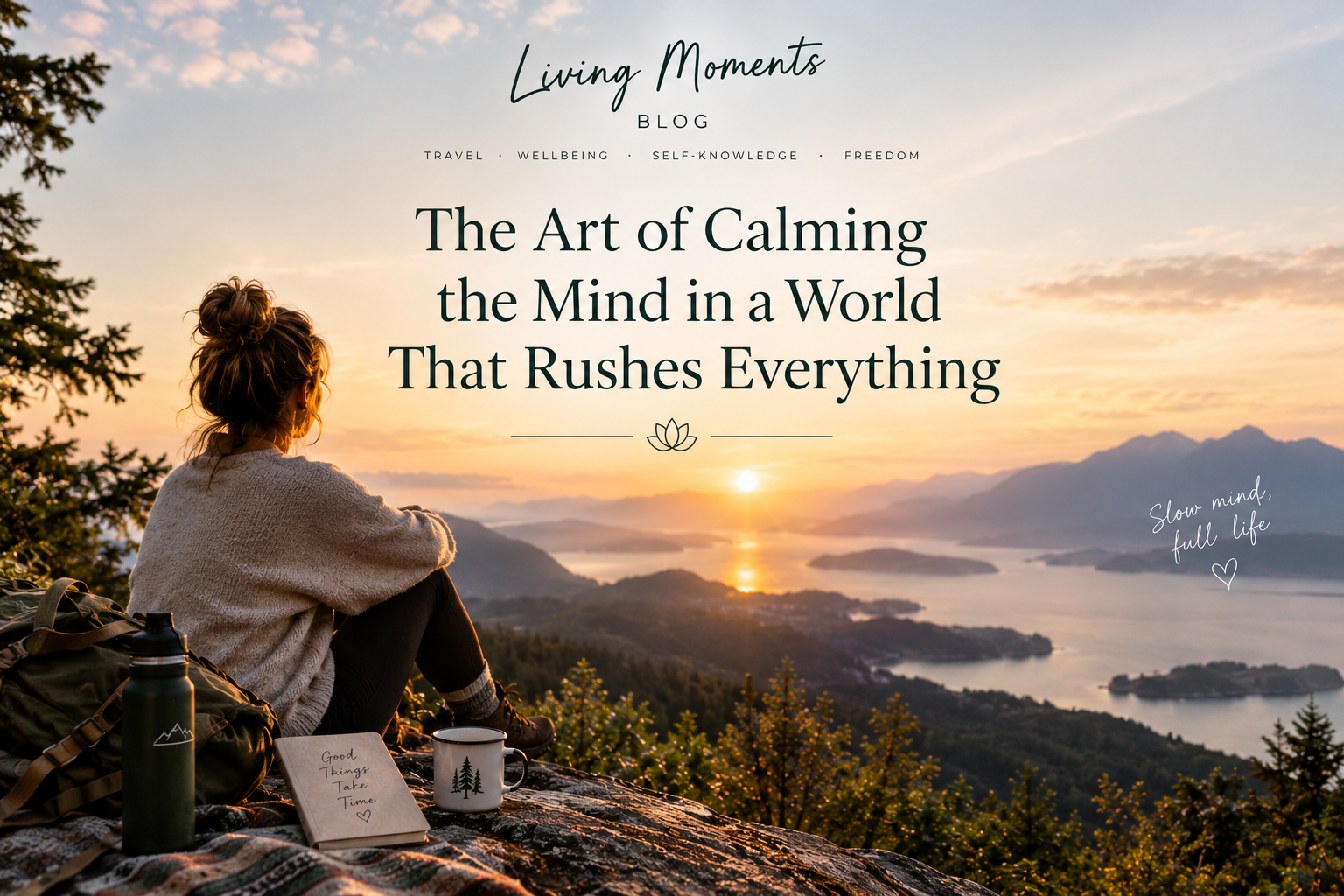
There are days when the mind becomes louder than reality.
We create stories in our heads.
We imagine conversations that never happened.
We anticipate endings before beginnings even have a chance to exist.
Sometimes it comes from anxiety.
Sometimes from loneliness, exhaustion, fear, emotional wounds, hormones, burnout, or simply the pressure of living in a world that never seems to slow down.
Modern life has normalized urgency. Cities are loud. Notifications are constant. Productivity became an identity. Rest started to feel like guilt.
But the human nervous system was never designed to live in permanent acceleration.
Why Our Minds Create Imaginary Scenarios
Psychology and neuroscience explain that the brain constantly tries to predict the future in order to protect us. This is part of survival mechanisms connected to the amygdala — the area involved in fear and emotional processing.
When we are stressed, sleep deprived, emotionally overwhelmed, or disconnected from ourselves, the brain tends to interpret uncertainty as danger.
That is when:
- overthinking increases,
- anxiety creates catastrophic scenarios,
- emotional triggers from the past resurface,
- and we begin reacting to imagined realities instead of present facts.
Research from institutions like Harvard Medical School and American Psychological Association has repeatedly shown how chronic stress affects emotional regulation, sleep quality, focus, mood, and even physical health.
The body remembers what the mind tries to ignore.
Emotional Maturity Is Learning to Pause
Not every feeling needs an immediate reaction.
Sometimes intelligence is not about having answers.
It is about knowing when to breathe before speaking.
Emotional maturity is recognizing:
- “Maybe I am tired.”
- “Maybe this fear comes from an old wound.”
- “Maybe I need rest, not panic.”
- “Maybe I am creating stories because I want certainty.”
This is not weakness.
This is self-awareness.
We often think maturity means becoming emotionally cold. But real maturity is becoming emotionally honest.
It is understanding that:
- hormones affect emotions,
- lack of sleep affects perception,
- unresolved trauma affects reactions,
- overstimulation affects the nervous system,
- and constant pressure disconnects us from ourselves.
Big Cities, Noise, and the Nervous System
Living in large cities can silently exhaust the mind.
Noise pollution, traffic, crowded environments, artificial lighting, constant urgency, and overstimulation increase cortisol levels — the stress hormone.
That is why many people feel emotionally disconnected without understanding why.
Nature regulates us.
Studies on “attention restoration theory” show that green spaces, silence, sunlight, and natural environments help restore mental energy and reduce stress and anxiety symptoms.
Sometimes healing is not dramatic.
Sometimes healing is:
- walking slowly,
- listening to music,
- watching the sunset,
- spending time with animals,
- practicing yoga,
- breathing deeply,
- singing,
- creating something,
- or simply allowing yourself to exist without rushing.
Your Mind Can Become a Safe Place Again
Many people experience:
- insomnia,
- emotional eating,
- anxiety crises,
- compulsive habits,
- emotional numbness,
- or constant mental exhaustion.
Each person copes differently.
But emotional healing often begins with one simple question:
“What is this feeling trying to tell me?”
Not suppressing emotions.
Not exploding because of them.
But redirecting them.
Pain redirected can become:
- art,
- movement,
- purpose,
- creativity,
- spirituality,
- self-knowledge,
- transformation.
This is part of emotional evolution.
You Are Allowed to Recalculate Your Life
Stoic philosophy reminds us that many things in life are outside our control:
- where we were born,
- the family we came from,
- certain circumstances,
- certain hardships.
But who we become is still being written.
You are not required to remain emotionally attached to an old version of yourself forever.
Life recalculates routes constantly.
People evolve.
Dreams evolve.
Identity evolves.
Healing evolves.
The world itself never stops changing.
So why should you believe you are permanently stuck?
How to Calm Yourself When Your Mind Feels Heavy
Here are a few scientifically supported ways to regulate emotional overwhelm:
1. Slow your nervous system physically
Deep breathing, stretching, yoga, walking, and grounding techniques help signal safety to the body.
2. Sleep before making emotional decisions
Sleep deprivation intensifies emotional reactivity and anxious thinking.
3. Reduce overstimulation
Less screen time, less noise, less comparison.
Silence is medicine too.
4. Name your emotions
Studies show that identifying emotions reduces activity in the brain’s fear center.
Instead of “Everything is wrong,” try:
- “I feel anxious.”
- “I feel overwhelmed.”
- “I feel afraid of uncertainty.”
5. Create moments of presence
Music. Reading. Art. Nature. Movement. Prayer. Journaling.
Anything that brings you back to the present moment instead of imagined futures.
Final Reflection
You do not need to solve your entire life in one night.
Not every delay is failure.
Not every silence is rejection.
Not every uncertainty is a disaster waiting to happen.
Sometimes life is simply asking you to slow down enough to hear yourself again.
The mind can be a place of chaos.
But it can also become a home.
And maybe healing begins the moment you stop fighting yourself and start listening with patience instead.
Post 2 — A Gentle Reflection for the Soul
Some seasons of life are not meant to be rushed.
The flower does not bloom faster because you stare at it impatiently.
The ocean does not calm because you scream at the waves.
And the heart does not heal simply because you demand it to.
Everything carries its own timing.
Sometimes we suffer not because reality is hurting us, but because our mind keeps trying to control what has not happened yet.
We create endings before beginnings.
We fear abandonment before love even arrives.
We replay old wounds and expect the future to repeat them.
But life is not a prison built from your past.
You are allowed to change.
You are allowed to rest.
You are allowed to outgrow versions of yourself that once survived difficult times.
There is no shame in needing silence.
No shame in slowing down.
No shame in taking time to understand your own emotions.
The world became addicted to speed.
But the soul has always spoken slowly.
Maybe that is why nature calms us:
because trees do not hurry,
sunsets do not compete,
and rivers do not question where they are going every second.
They simply flow.
And perhaps we were never meant to live as machines either.
You are not behind in life because your journey looks different.
You are not failing because your path requires more healing.
You are not weak because you feel deeply.
Sometimes the strongest thing a person can do is pause before becoming someone they are not.
There are things your future self will understand that your present self cannot yet explain.
So breathe.
Not everything needs an answer tonight.
Not every emotion needs to become a decision.
Not every storm inside you is permanent.
You are still becoming.
And that is a beautiful thing.
