
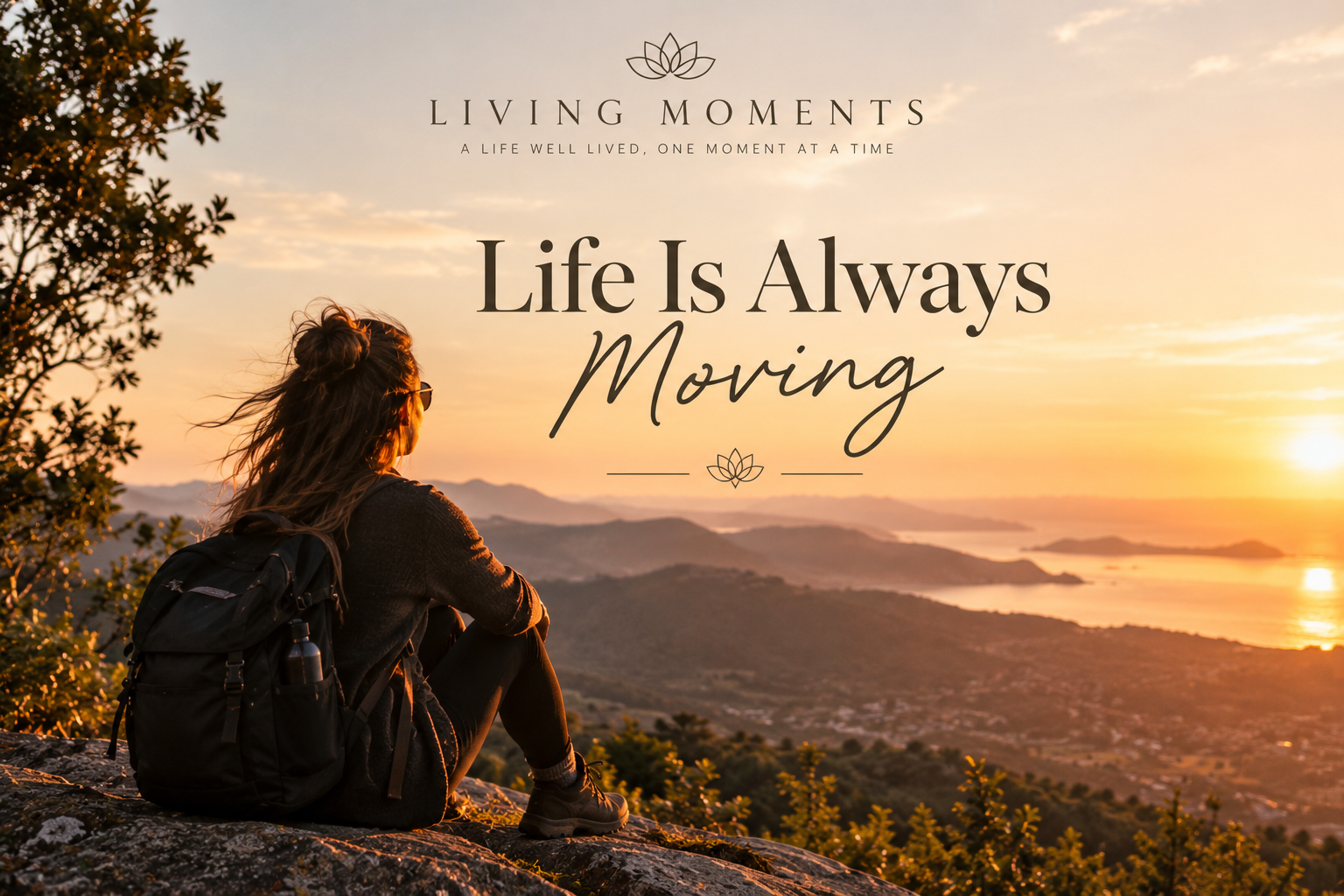
There is something strangely comforting about realizing that life never truly stays still.
No emotion remains forever.
No season fully repeats itself.
No version of us survives unchanged.
Even when life feels unbearably heavy, confusing, lonely, or uncertain — something beneath the surface is always moving.
Healing moves.
Time moves.
The nervous system adapts.
The mind reorganizes.
The body learns.
The soul evolves.
And eventually, even pain transforms into something else.
Sometimes wisdom.
Sometimes softness.
Sometimes boundaries.
Sometimes strength.
One thing that comforts me is knowing that every phase eventually passes.
Every version of us leaves something behind for the next one.
The exhausted version.
The grieving version.
The anxious version.
The hopeful version.
The version that survived silently.
The version that started over.
The version that felt completely lost.
None of them disappear completely.
They become layers.
Fragments of identity carried into the next chapter.
Psychology often describes emotional healing as a process of adaptation rather than erasure.
We do not simply “move on.”
We reorganize internally around our experiences.
This is why growth rarely feels linear.
Some days we feel healed.
Some days we feel fragile again.
Some days the nervous system remembers old fears even after the danger has passed.
That does not mean healing failed.
It means we are human.
One of the most powerful concepts in psychology is emotional flexibility:
the ability to experience difficult emotions without becoming trapped inside them forever.
People often think healing means reaching permanent happiness.
But emotional health is not emotional perfection.
It is movement.
It is learning how to let emotions pass through us without allowing them to define our entire identity.
Even storms move eventually.
Buddhist philosophy speaks deeply about impermanence — the understanding that everything in life is temporary:
joy,
pain,
attachment,
fear,
certainty,
identity,
and even suffering itself.
At first, this idea can feel frightening.
But eventually it becomes liberating.
Because if painful seasons are temporary, then hopelessness is temporary too.
The life you are living right now is not the final version of your story.
Your current emotional state is not your permanent identity.
You are allowed to evolve beyond the person you were during survival mode.
Research on post-traumatic growth also shows that many people develop deeper emotional resilience, stronger personal meaning, and greater self-awareness after periods of adversity.
Not because suffering is beautiful.
But because humans are remarkably adaptive.
The mind and body constantly try to rebuild safety, understanding, and stability after disruption.
Life itself is movement.
Nature understands this.
The ocean changes every second.
The seasons never stay.
Trees lose leaves and bloom again.
The body replaces cells continuously.
Even the brain physically changes through neuroplasticity.
Nothing alive remains frozen forever.
And maybe that is what we need to remember during difficult seasons:
this moment is not permanent.
The version of you reading this today will someday become a memory too.
And one day, you may look back and realize:
you survived a phase you once thought would break you.
Not because life stopped hurting immediately.
But because life kept moving.
And eventually, so did you.
Reflection
Maybe healing is not about becoming someone entirely new.
Maybe it is about learning how to keep flowing through change without abandoning yourself in the process.
Quote
“Life is always moving.
Even when you feel stuck,
something inside you is still becoming.”
— Living Moments
